
While many contracts include basic auto-renewal clauses, true renewal automation is a different beast. Results vary widely based on how well your CRM data, outreach workflows, and timing logic are configured. A poorly configured automation system doesn't save time, it scales your existing problems, sending renewal notices to lapsed contacts and triggering alerts for incorrect dates.
This guide walks through the exact prerequisites, step-by-step setup, key variables, and mistakes to avoid when automating subscription contract renewals. You'll learn how to build a system that prevents churn, recovers revenue, and frees your team from manual tracking.
Key Takeaways
- Automating renewals requires CRM-based triggers, multi-channel workflows, and renewal logic built on top of any auto-charge setup
- Clean CRM data is the foundation: bad fields break automations before they start
- Start outreach 60–90 days before expiry for manual renewals, 30–45 days for auto-renewing contracts
- Segment by renewal type and health score so the right workflow and message reach each customer
- Monitor renewal rates, churn signals, and outreach performance to continuously improve your system
What You Need Before Automating Subscription Contract Renewals
Poor data quality undermines automation before it starts. $12.9 million (approximately ₹107.1 crore) quality costs organizations an average of ₹107 crore (≈ $12.9 million) annually, with 44% of companies experiencing revenue losses exceeding 10% specifically attributed to data decay. Preparation directly determines output quality.
CRM and Contract Data Readiness
Before building a single workflow, ensure these critical fields are accurately populated in your CRM for every active subscription:
- Contract Start & End Date
- Contract Term (monthly, annual, multi-year)
- Billing Frequency
- Payment Terms
- Auto-Renewal flag (Yes/No)
- Termination Notice Period
- ARR or Total Contract Value (TCV)
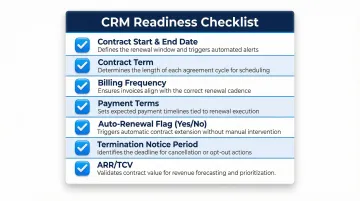
Without these fields, no trigger logic can fire correctly. B2B contact data decays at roughly 2.1% per monthover 22% annually meaning 23-30% of email addresses and 18% of phone numbers become outdated each year. Automated renewal notices sent to wrong contacts don't just fail; they damage customer trust.
Workflow and Tooling Requirements
Identify which tools you'll use:
- A CRM (Salesforce, HubSpot, or equivalent) for storing contract data and triggering workflows
- A contract management or e-sign platform for document generation, version control, and digital signatures
- An outreach layer email sequences, SMS, voice calls, or AI-driven communication tools
Verify whether these systems are already integrated or will require API setup. Custom fields and data mapping frequently need configuration even when native integrations exist budget time for this before your go-live date.
Team and Compliance Readiness
Align stakeholders from Legal, Finance, and Customer Success before launch. Auto-renewal language must meet applicable legal standards in your operating regions. California's amended Automatic Renewal Law (effective July 2025) requires express affirmative consent and frictionless online cancellation, while the FTC continues aggressive enforcement under ROSCA.
On the access side, establish role-based controls that define who can trigger or override renewal workflows. Modifying contract terms or manually pushing renewal documents should be restricted to authorized team members only.
How to Automate Subscription Contract Renewals: Step-by-Step
Step 1: Audit Your Current Renewal Process
Map out how renewals currently work:
- Are dates tracked in spreadsheets or CRM?
- Where do delays most commonly occur data gaps, approval lag, or missed outreach?
- Which contracts are on auto-renewal vs. manual renewal?
90% of firms still rely on spreadsheets for financial operations, and 91% of companies lack a centralized dashboard tracking renewal status. Document the bottlenecks before configuring any automation. Auto-renewal and manual renewal contracts require different workflows, different outreach cadences, and different CRM field structures.
Step 2: Centralize All Contracts in a Single Repository
Migrate contracts from email threads, shared drives, and spreadsheets into a centralized cloud-based system with a standardized folder and naming structure. This makes date-triggered alerts possible.
Set up role-based access so only authorized team members can edit terms or trigger renewal actions. Verify backup and encryption standards are in place for sensitive contract data. A centralized repository eliminates duplicate contracts, version conflicts, and missed deadlines.
Step 3: Configure Automated Renewal Alerts and Triggers
Set up date-based alerts in your CRM or contract tool:
- Non-auto-renewing contracts: Trigger outreach at 90 days and 60 days before expiry
- Auto-renewing contracts: Trigger notification email at 45 days and follow-up at 30 days
Companies that start renewal conversations 90 days in advance achieve average savings of 49%, compared to just 19% when starting between 30 and 90 days before renewal. Starting late leaves no room for renegotiation, legal review, or resolving objections before the deadline.
Create separate alert queues for internal stakeholders (Customer Success, Legal, Finance) vs. customer-facing communications. Internal alerts should fire earlier than customer-facing ones to allow review and personalization.
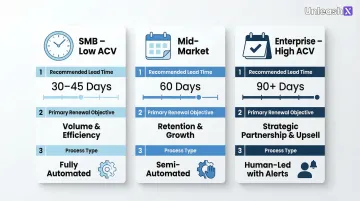
| Customer Segment | Recommended Lead Time | Primary Objective | Process Type |
|---|---|---|---|
| Enterprise (High ACV) | 90+ Days | ROI review, budget approval | Human-led with automated alerts |
| Mid-Market | 60 Days | Value reinforcement, adoption check | Semi-automated |
| SMB (Low ACV) | 30-45 Days | Transactional notification | Fully automated |
Step 4: Automate Multi-Channel Customer Outreach
Build email workflow templates for each renewal scenario:
- Auto-renewal confirmation emails
- Non-auto-renewal "action required" emails with draft order forms
- At-risk account re-engagement sequences
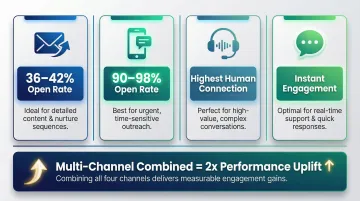
Personalize using CRM merge fields (contact name, renewal date, ARR, account manager). That said, email alone is no longer enough. B2B email open rates sit at 36.7%–42.35%, but over 50% of those opens occur on Apple devices with Mail Privacy Protection activated, inflating the numbers and masking true engagement.
Customers who ignore their inbox respond on other channels. SMS messages boast open rates of 90-98%, with 90% read within three minutes of receipt. Multi-channel outreach outperforms single-channel by 2x in most field studies.
Platforms like UnleashX take this further with AI employees that autonomously contact subscribers via voice calls, WhatsApp, and chat. They follow up on renewal notices, answer questions, and guide customers through the process 24/7 without manual intervention.
Define escalation rules: if a customer doesn't respond to the first two touchpoints within a set number of days, automatically escalate to the assigned Account Manager or CSM for personal outreach.
Step 5: Define Renewal Workflow Logic and Approval Chains
Build conditional workflow logic:
- Straight renewals (no pricing change, no term modification): Auto-generate the renewal document and route it to the customer for e-signature
- Pricing changes or custom terms: Route through an internal approval chain first
Configure co-terming, upsell, and cross-sell triggers within the renewal workflow. When a customer's usage data exceeds a threshold or they show engagement signals, the workflow should surface an upsell offer as part of the renewal document.
Step 6: Monitor Performance and Continuously Optimize
Track these KPIs post-launch:
- Overall renewal rate
- Average time-to-renewal-close
- Number of renewals requiring manual intervention
- Churn rate among auto-renewed accounts
- Email/call engagement rates in your outreach sequences
Set a monthly review cadence to analyze which outreach touchpoints drive the most renewals and which customer segments have the highest drop-off. Use this data to refine trigger timing, message templates, and escalation thresholds.
Key Variables That Affect Renewal Automation Success
Two companies can follow the same automation steps and get dramatically different results. What separates them is how well they control these four variables.
CRM Data Quality
Every automated trigger, outreach template, and renewal document relies on CRM field values. If the contract end date, billing contact, or ARR is wrong, the entire chain misfires or targets the wrong person.
70% of CRM data contains outdated, incomplete, or inaccurate information which breaks automated triggers before they even fire. Organizations that prioritize data accuracy report 25% improvements in sales productivity, cutting the time reps spend validating records and freeing them to focus on negotiating renewals.
Renewal Lead Time (When You Start)
Starting too late inside 30 days for a non-auto-renewing enterprise contract leaves no room for renegotiation, legal review, or addressing objections. Starting too early for SMB accounts creates unnecessary alert noise. The right answer is to segment lead times by customer type.
OpenView Partners' research shows companies that start renewal discussions at least 90 days out achieve 15-20% higher renewal rates than those starting later. Within 30-60 days, switching costs feel prohibitive and buyers lose negotiating leverage so you get renewals, but at your terms, not theirs.
Outreach Channel and Frequency
Email-only outreach is losing ground. Cold outreach reply rates dropped from 6.8% in 2023 to 5.8% in 2025 as inbox fatigue climbs. A customer who ignores three renewal emails may respond immediately over WhatsApp or pick up a voice call.
Multi-channel outreach where an AI employee conducts real-time voice and chat conversations, answers renewal questions, and confirms intent consistently outperforms single-channel sequences. Combining email, phone, and messaging delivers a 25%+ engagement uplift.
Customer Health and Segmentation
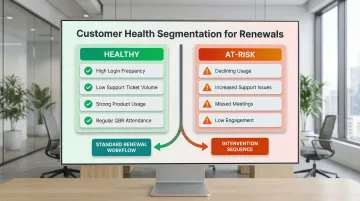
Sending the same renewal flow to an engaged power user and a dormant user who hasn't logged in for 60 days wastes both. Health scoring lets you route at-risk accounts into a higher-touch intervention before the renewal window closes. Define the two buckets clearly:
- Healthy: High login frequency, low support ticket volume, strong product usage metrics, regular QBR attendance
- At-Risk: Declining usage, increased support issues, missed meetings, low engagement
Renewed accounts had 2x more QBRs than churned accounts, and customers that renewed were 50% more engaged in the quarter prior to renewal. Configure your automation to route at-risk accounts toward intervention sequences rather than standard renewal flows. Companies that implement sophisticated customer segmentation achieve 15-20% higher renewal rates than those using basic approaches.
Common Mistakes When Automating Subscription Contract Renewals
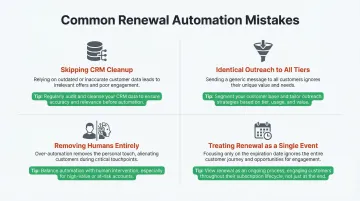
Most automation failures aren't technical, they're strategic. Here are the four mistakes that consistently undermine renewal workflows:
Skipping CRM data cleanup before building triggers. Teams often set up automation first and assume data will be fixed later. The result: alerts fire on wrong dates, renewal documents reach lapsed contacts, and billing errors erode customer trust. Audit and clean CRM fields before any workflow goes live.
Sending identical outreach to every customer tier. Enterprise accounts expecting negotiation shouldn't receive the same 30-day template as an SMB on a ₹8,200 (≈ $99)/month plan. Segment workflows by customer tier, renewal type (auto vs. manual), and account health before launching any automation.
Removing humans from the process entirely. Fully automated renewals without an escalation trigger let at-risk enterprise accounts churn without intervention. 62% of users who encounter a payment error never return to the merchant's site making false declines a compounding revenue risk. Configure a human-in-the-loop step for high-value accounts and any account signaling dissatisfaction.
Treating renewal as a single event rather than a lifecycle. The most upstream mistake: activating outreach only 30 days out. Renewal success is built 6–9 months in advance through health checks, usage reviews, and consistent engagement touchpoints not a last-minute email sequence.
When to Automate vs. Keep Renewals Manual
Not every contract belongs in an automated renewal workflow. The right approach depends on three factors: volume, contract complexity, and relationship intensity.
Automation works best for:
- High-volume accounts (hundreds to thousands) with standardized contract terms
- Predictable billing amounts that require no custom negotiation
- SMB SaaS subscriptions, recurring software licenses, and usage-based digital service plans
Keep renewals manual or semi-automated when:
- The account is a strategic enterprise customer with custom pricing or complex terms
- The renewal involves significant upsell negotiation
- The account has shown churn signals requiring personal intervention
In these cases, automation should support the CSM alerts, document generation, reminders bu$2 million (approximately ₹16.6 crore)ace human judgment. Industry benchmarks put each CSM's capacity at roughly ₹16.6 crore (≈ $2 million) in annual contract value (ACV); high-touch enterprise accounts demand considerably more time for relationship building and value realization.
Frequently Asked Questions
Can a contract be renewed automatically?
Yes, contracts can be set up with auto-renewal clauses that extend the agreement at a predefined date without requiring manual action. However, there's a difference between an auto-renewal clause (a legal term in the contract) and a full renewal automation workflow (the operational system that manages outreach, billing, and documentation).
How do Indian B2B SaaS firms automate subscription renewals?
Indian B2B SaaS companies (Zoho, Freshworks, Razorpay, BrowserStack, Postman) use AI-driven renewal automation tied to GST e-invoicing, MCA-compliant contract storage, and CFO-led approval workflows. WhatsApp and email reminders in English plus the buyer's regional language reduce renewal slippage in Indian mid-market accounts where finance teams often run on quarterly review cycles.
How to automate customer follow-ups?
Customer follow-ups can be automated through CRM-based email sequences and further extended through AI-powered tools that handle voice, chat, and WhatsApp outreach autonomously. This ensures every renewal touchpoint gets a response without requiring manual intervention from your team.
What Indian regulations affect contract renewal automation?
GST e-invoicing rules apply to renewal invoices for businesses above the threshold, requiring IRN generation. The Information Technology Act governs electronic contracts and digital signatures (eSign / Aadhaar OTP / DSC). Stamp duty is state-specific and must be handled per the state of execution. MCA filings apply for material contracts above thresholds.
Are renewal automation platforms cost-effective for Indian SMEs?
Yes. Indian SaaS pricing is INR-denominated and modular, so SMEs can start with renewal reminders, expand to e-signature integration, and finally add quote-to-cash automation. Common starting points include WhatsApp renewal nudges, automated GST-compliant invoice generation, and CRM-linked dunning, each delivering measurable churn reduction in months.
What is the best contract automation software?
The best software depends on your stack and needs. Common options include CRM-native tools (Salesforce, HubSpot), dedicated contract platforms (Gatekeeper, Trackado, DealHub), and outreach automation layers. The most effective setups combine contract storage with multi-channel follow-up to keep every renewal on track.