
Introduction
Most teams building voice apps hit the same wall: solutions either demand deep coding expertise, force you to stitch together disconnected tools, or lack the CRM integrations needed to produce measurable results.
Low-code AI platforms are changing that enabling teams to deploy intelligent voice apps in hours rather than months, without a dedicated development team.
The conversational AI market is projected to reach $49.80 billion (approximately ₹413,300 crore) by 2031 at a CAGR of 19.6%, and Gartner estimates it will cut c$80 billion (approximately ₹664,000 crore)er labor costs by ₹664,000 crore (≈ $80 billion) by 2026.
Choosing the right platform makes or breaks those outcomes. The tools that deliver sub-second latency, seamless CRM sync, end-to-end workflow automation look very different from those that don't.
Key Takeaways
- Low-code AI integration tools let teams deploy intelligent voice agents without significant coding
- Top platforms pair voice AI with workflow automation, CRM sync, and multi-channel outreach in a single stack
- Key selection criteria: latency under 800ms, language coverage, integration depth, transparent pricing, and time-to-deploy
- UnleashX, Latenode, Vapi, Retell AI, and Bland AI lead the field each built for different use cases and team sizes
- Sales, support, and HR teams report 8X higher conversions, 30% recovered cart revenue, and 53% automation rates after deployment
Overview of Low-Code AI Integration Tools for Voice Apps
Low-code AI integration tools for voice apps are platforms that allow non-developers or lean technical teams to build, deploy, and manage AI-powered voice agents covering inbound/outbound calling, real-time transcription, intent detection, and post-call workflow automation without building infrastructure from scratch.
The pan-India conversational AI market is expanding rapidly, driven by enterprise demands to reduce contact center labor costs and improve$49.80 billion (approximately ₹413,300 crore) engagement. The market is projected to reach ₹413,340 crore (≈ $49.80 billion) by 2031 at a 19.6% CAGR.
Adoption is accelerating across industries. Recent surveys show:
- 23% of organizations are actively scaling agentic AI systems in at least one business function
- An additional 39% have already begun experimenting
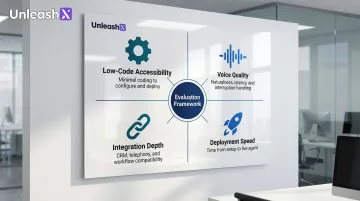
Businesses in high-volume sectors like insurance, banking, automotive, and e-commerce are moving fastest because these tools let teams ship production-ready voice agents without dedicated engineering resources. The platforms evaluated below were selected across four criteria:
- Low-code accessibility : minimal coding required to configure and deploy
- Voice quality : naturalness, latency, and handling of interruptions
- Integration depth : CRM, telephony, and workflow compatibility
- Deployment speed : time from setup to live agent
Top 5 Low-Code AI Integration Tools for Voice Apps
These tools were evaluated on ease of deployment, voice quality, CRM and workflow integration, pricing transparency, scalability, and suitability for business use cases beyond basic voice bots.
UnleashX
UnleashX is a full-stack AI employee platform purpose-built for high-volume business operations. Rather than offering standalone voice bots, it deploys autonomous AI employees such as Peter for sales and Sarah for cart recovery that handle end-to-end workflows across voice, WhatsApp, and chat, with CRM updates handled automatically.
Key capabilities that set it apart:
- Go live in 45 minutes using production-ready, pre-built templates
- Supports 100+ languages and 12+ Indian languages including Tamil and Bangla
- Delivers sub-700ms latency with 98% accuracy across voice, chat, and WhatsApp
- Orchestrates natively across 200+ tools including Salesforce, HubSpot, and Calendly
This makes it the right fit for enterprises that need voice AI capable of closing leads, recovering carts, and screening candidates not just answering calls.
| Key Features | Pricing | Best For |
|---|---|---|
| Full-stack AI employees for sales, support, and HR; voice + WhatsApp + chat; 200+ tool integrations including Salesforce, HubSpot, Asana, and Calendly; 100+ languages; Human-in-Loop oversight; GDPR and IRDAI compliance monitoring | Subscription bundles: Starter at ₹4,100 (≈ $49)(~600 calling minutes), Growth at ₹24,800 (≈ $299)(~3,900 minutes), Enterprise at ₹1.7 lakh (≈ $1,999)(~27,000 minutes) | Enterprises and mid-market teams in insurance, automotive, e-commerce, and SaaS needing autonomous voice AI that connects directly to CRMs and closes workflows end-to-end |
Latenode
Latenode is a low-code automation platform that extends AI voice agents into full business workflows. It connects phone interactions to CRMs, scheduling tools, and communication platforms using a visual workflow builder powered by 5,500+ integrations across 1,200+ apps and LLMs including OpenAI, Claude, and Gemini.
The platform bridges the gap between a voice call and downstream business actions logging call data, triggering follow-up emails, updating CRM records, and managing multi-channel sequences all configured visually without deep coding expertise. Usage-based pricing starting at ₹1,600 (≈ $19)/month keeps it accessible for smaller teams.
| Key Features | Pricing | Best For |
|---|---|---|
| Visual low-code workflow builder; 5,500+ integrations across 1,200+ apps/LLMs; dedicated voice product (SpeakNode); webhook-based voice triggers; CRM sync; multi-channel follow-up automation | Start plan: ₹1,600 (≈ $19)/month (25,000 workflow executions); Team plan: ₹4,900 (≈ $59)/month (250,000 executions, 5 team members) | SMBs and mid-market teams that want to automate what happens after a voice call from CRM updates to appointment scheduling and lead scoring |
Vapi
Vapi is a developer-friendly voice AI API platform that has processed over 300 million calls and launched 2.5 million assistants. It provides pre-built infrastructure for real-time voice conversations, including speech recognition, LLM integration, and text-to-speech, without teams having to build or manage the audio pipeline themselves.
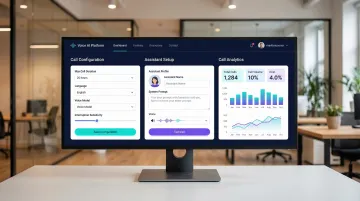
The low-code dashboard lets non-engineers configure voice agents, set personas, and connect to phone numbers. It supports inbound and outbound calling with sub-500ms interactions, real-time interruption handling, and webhooks for downstream integrations. Instawork used Vapi to scale phone screens 50X, going from concept to high-volume production in roughly 30 days.
| Key Features | Pricing | Best For |
|---|---|---|
| Real-time voice agent builder; inbound/outbound calling; LLM-agnostic (GPT, Claude, Gemini); SIP trunking; webhook integrations; low-code dashboard configuration; custom voice personas | ₹4 (≈ $0.05)/minute hosting cost plus model provider costs; includes 10 concurrent calls with ₹830 (≈ $10)free credit to start | Product teams and technical founders who want a flexible, API-first voice AI platform with low-code configuration options for fast prototyping and deployment |
Retell AI
Retell AI is a low-code platform built specifically for deploying production-grade AI voice agents. It offers a visual agent builder, telephony integration with Twilio and Vonage, and pre-built templates for common use cases like appointment booking, lead qualification, and customer support.
Its built-in agent testing environment and analytics dashboard let teams monitor call success rates, interruption patterns, and task completion without custom instrumentation cutting the time between build and production. The platform achieves an average end-to-end latency of 620ms, and clients like Everise resolve 65% of voice calls autonomously.
| Key Features | Pricing | Best For |
|---|---|---|
| Visual voice agent builder; pre-built templates; telephony integrations (Twilio, Vonage); agent testing sandbox; call analytics dashboard; LLM-powered conversation flows; Warm Transfer with full conversational context | Pay-as-you-go: ₹6 (≈ $0.07)to ₹26 (≈ $0.31)/minute for AI Voice Agents; includes ₹830 (≈ $10)in free credits and 20 free concurrent calls | Customer-facing teams needing a ready-to-deploy voice agent for appointment scheduling, lead qualification, or inbound support with strong analytics and testing built in |
Bland AI
Bland AI is a scalable AI phone calling platform designed for businesses that need to run high-volume outbound or inbound voice campaigns. It provides a programmable interface for building voice agents that can handle thousands of concurrent calls, with simple API and low-code pathway builders for configuring conversation logic.
Its "Conversational Pathways" feature lets users visually map branching call flows without writing code. It also supports dynamic variable injection pulling contact data from a CRM mid-call via external API requests plus custom voice cloning and real-time handoff to human agents. An Austin-based financial services firm used Bland AI to automate 50,000 outbound calls per month, generating ₹1.3 crore (≈ $154,000)in additional revenue within 60 days.
| Key Features | Pricing | Best For |
|---|---|---|
| High-volume concurrent calling; visual conversational pathways; dynamic variable injection via API; custom voice cloning; human handoff; CRM and webhook integrations; self-hosted infrastructure | Start tier (free): ₹12 (≈ $0.14)/min, 10 concurrent calls; Build plan: ₹24,800 (≈ $299)/month + ₹10 (≈ $0.12)/min, 50 concurrent calls; Scale plan: ₹41,400 (≈ $499)/month + ₹9 (≈ $0.11)/min, 100 concurrent calls | Sales and operations teams that need to scale outbound AI calling campaigns with programmable, low-code conversation flows and high concurrent call handling |
How We Chose the Best Low-Code AI Integration Tools for Voice Apps
Every tool on this list was evaluated on one core question: does it reduce the technical barriers to deploying voice AI while connecting those interactions to real business outcomes? The most common pitfalls are impressive demos with poor CRM integration, ignoring latency, or platforms that handle voice but drop the ball on post-call workflows that shaped each criterion below.
Five criteria drove the evaluation:
Latency (the 800ms threshold). Contact centers report a 40% increase in call abandonment when AI voice agents exceed 1 second response time. Production systems need to hold at 800ms or lower past that point, users notice, conversations overlap, and trust erodes fast.
CRM integration depth. A voice agent without read/write CRM access$12.9 million (approximately ₹107.1 crore)ive IVR, nothing more. Poor data quality already costs organizations at least ₹107 crore (≈ $12.9 million) annually, and 20–30% of enterprise revenue leaks from data inefficiencies. True integration eliminates manual post-call admin, saving roughly 2 minutes per call across thousands of daily interactions.
Speed-to-lead and language coverage. Contacting a lead within 5 minutes delivers 8X higher conversion rates, yet 77% of leads go uncontacted. Autonomous outbound agents close that gap around the clock. For deployment across Indias, language support matters: UnleashX, for instance, covers 100+ languages including 12+ Indian vernaculars, which is a real differentiator for regional markets.
Compliance readiness. Enterprise use cases require GDPR, IRDAI, and CCPA coverage not as add-ons, but built into the platform with audit trails, consent management, and full data traceability.
Usage-based pricing. Per-seat licensing models don't scale well for voice AI. Modern platforms charge ₹4 (≈ $0.05)–₹12 (≈ $0.14)per minute, letting enterprises expand capacity without proportional headcount costs.
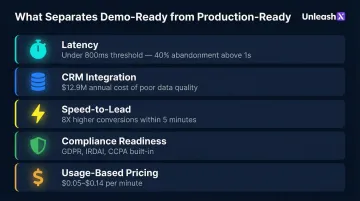
Together, these criteria separate tools that demo well from tools that hold up in production.
Conclusion
Low-code AI integration tools for voice apps have matured significantly. The right platform can cut go-live time to under 45 minutes while delivering production-ready voice quality, CRM automation, and compliance coverage.
Evaluate tools based on your specific workflow needs, not just surface-level features. A tool that handles voice well but requires manual CRM updates or lacks multi-language support creates new bottlenecks rather than eliminating them.
The right category depends on your use case:
- Middleware API : Vapi, Retell AI (developer-first voice infrastructure)
- Workflow automation bridge : Latenode (connecting apps without code)
- High-volume enterprise infrastructure : Bland AI (scale-focused deployments)
- Full-stack AI employee : UnleashX (autonomous end-to-end workflow execution)
For teams that want a voice AI solution that goes beyond basic bots, one that closes leads, recovers carts, screens candidates, and syncs with existing CRMs out of the box. UnleashX offers pre-built AI employees deployable in under an hour. Explore a demo or reach out via WhatsApp at +919911997433.
Frequently Asked Questions
What are the best low-code AI tools and APIs for voice apps?
The top options include UnleashX for full-stack AI employee deployment with 45-minute go-live, Latenode for workflow automation around voice interactions, Vapi for API-first voice agent building with sub-500ms latency, Retell AI for ready-to-deploy voice templates with built-in analytics, and Bland AI for high-volume calling campaigns. Your best fit depends on whether you need a standalone voice bot or a full AI employee that handles end-to-end workflows including CRM sync and follow-ups.
What are the best no-code AI tools?
No-code AI tools like UnleashX, Retell AI, and Latenode let teams deploy voice agents without writing code, using visual builders and pre-built templates. UnleashX offers production-ready AI employees in 45 minutes; Retell AI provides visual agent builders with testing sandboxes.
What is the difference between no-code and low-code AI voice tools?
No-code tools require zero programming and rely entirely on visual configuration through drag-and-drop interfaces and pre-built templates. Low-code tools offer visual interfaces with the option to add custom scripts, API calls, or webhook integrations for complex use cases. Both work for non-developers, but low-code tools offer more flexibility for advanced integrations and custom logic.
How do AI voice agents handle Hindi and regional languages for Indian customers?
Modern voice AI platforms support natural conversations in Hindi, Tamil, Telugu, Kannada, Marathi, Bengali, and code-mixed Hinglish. UnleashX voice agents detect caller language automatically, switch mid-call where needed, and integrate with WhatsApp for follow-ups, which matches how Indian buyers in BFSI, real estate, and D2C actually engage.
Which Indian companies are deploying AI voice agents in production?
Indian BFSI majors (HDFC, ICICI, SBI, Axis), real estate firms, lending NBFCs, and D2C brands are running voice AI in production for sales calls, KYC follow-ups, and customer support. NASSCOM has tracked rapid adoption across IT services and BPO firms (TCS, Infosys, Wipro, HCLTech) building voice AI practices for Indian and pan-India enterprise clients.
What Indian regulations should I consider before deploying voice AI?
DPDP 2023 governs personal data handling in voice interactions, including consent capture and audit trails. RBI guidelines on outsourcing apply to BFSI deployments, IRDAI rules cover insurance workflows, and TRAI's commercial communication rules govern outbound calling. Production-grade voice AI platforms maintain call recordings, language logs, and consent receipts to meet these requirements.