
Introduction
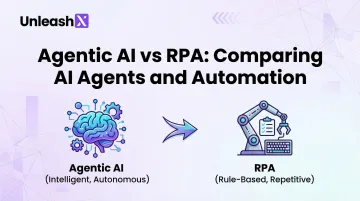
Businesses today face a critical automation crossroads: continue investing in traditional Robotic Process Automation (RPA), or embrace the emerging capabilities of agentic AI? The choice directly impacts operational costs, scalability, and the types of workflows you can automate end-to-end.
RPA has served as the automation workhorse for years, delivering predictable results for structured, high-volume tasks. But its rigid architecture creates a "fragility tax": 30-50% of RPA projects fail to scale, and maintenance consumes up to 50% of initial build costs annually.
Agentic AI is expanding what automation can actually do handling unstructured data, making contextual decisions, and orchestrating complex workflows autonomously across systems.
The challenge? While 79% of enterprises have adopted AI agents, only 11% have successfully moved them into production. This article clarifies when to choose RPA, when to deploy agentic AI, and how mature enterprises are combining both to build hybrid automation architectures that maximize ROI while expanding automation coverage.
In India, NASSCOM has tracked agentic AI adoption accelerating fastest across BFSI, IT services, and D2C, where multilingual customer engagement and Hindi or regional-language workflows expose the limits of pure rule-based RPA.
Key Takeaways
- RPA automates structured, rule-based tasks through pre-programmed scripts ideal for stable processes with predictable inputs
- Agentic AI autonomously perceives context, reasons through decisions, and executes multi-step workflows across unstructured data and dynamic environments
- RPA breaks when processes change or inputs vary; agentic AI adapts to exceptions, ambiguity, and real-time conditions
- They work best together: RPA handles rule-based backend execution while agentic AI manages the reasoning and decision layer
- Use RPA for high-volume, stable workflows use agentic AI when tasks require judgment, real-time adaptation, or customer-facing decisions
Agentic AI vs RPA: Quick Comparison
| Capability | RPA | Agentic AI |
|---|---|---|
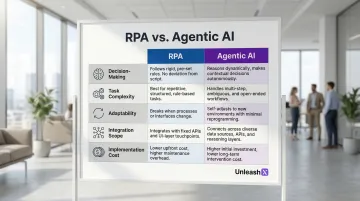
| Decision-Making | Follows pre-defined rules with no independent judgment; stops when encountering unexpected inputs | Reasons through context, selects actions dynamically, handles ambiguity and exceptions autonomously |
| Task Complexity | Best for simple, repetitive, structured tasks (data entry, form fills, file transfers) | Handles multi-step, cross-functional workflows involving unstructured data, language, and judgment |
| Adaptability | Brittle to change; process updates require manual bot reprogramming | Learns and adapts; adjusts behavior based on new instructions, data, or contextual signals |
| Integration Scope | Operates within specific apps via UI or APIs; limited to structured interfaces | Orchestrates across systems, tools, databases, and channels: CRMs, APIs, email, chat, and voice all simultaneously |
| Implementation Cost | Lower upfront setup for simple processes; maintenance costs compound over time | Higher initial configuration, but the ROI scales broadly: production-grade agents achieve 171% ROI |
What is RPA?
Robotic Process Automation (RPA) uses software robots to replicate human interactions with digital systems by following explicit, step-by-step rules. These bots handle clicks, form fills, copy-paste operations, and data extraction from structured sources fast and consistently.
Core strengths include:
- Processes thousands of transactions with near-zero error rates
- Runs continuously, 24/7, without fatigue or downtime
- Logs every action for full auditability and compliance tracing
- Deploys simple workflows in days, not months
The pan-India RPA market reached $3.6 billion in 2024 (approximately ₹30,000 crore) and is projected to grow at 29% annually, driven primarily by Banking, Financial Services, and Insurance (BFSI), which accounts for 36.5% of market revenue. 74% of organizations are already implementing RPA technologies across operations. That adoption is concentrated where processes are predictable and volume is high.
Use Cases of RPA
RPA fits best where input and output formats are fixed:
- Thermo Fisher Scientific processes 824,000 invoices annually with 70% time reduction
- BAE Systems increased payroll upload speeds by 7x through automated data entry
- Automated regulatory filings generate complete audit trails with no manual intervention
- EXL cut insurance claims processing time by 60% with zero errors
- NGA Human Resources saved 13,000 hours annually by automating HR access management
RPA breaks the moment a process changes. Unstructured data (variable-format emails, non-standard PDFs) or any scenario requiring interpretation will stop a bot cold. When your SaaS vendor updates their UI or a customer submits an unusual form, the workflow fails, and fixing it consumes 30-50% of build costs annually.
What is Agentic AI?
Agentic AI represents a fundamental shift from rule-based execution to goal-driven autonomy. Unlike chatbots that merely retrieve information or RPA bots that follow scripts, agentic AI systems act independently to achieve specific goals without requiring constant human intervention. McKinsey defines an AI agent as software that has agency to perform tasks, orchestrate complex workflows, coordinate activities among multiple agents, and apply logic to thorny problems.
The four operational stages of agentic AI:
- Perception - Gathering context from inputs across structured and unstructured data sources
- Reasoning - Deciding what action to take based on goals, context, and constraints
- Action - Executing across tools, systems, APIs, and communication channels
- Learning - Refining behavior based on outcomes and feedback
Core benefits tied to operational impact:
- Handles exceptions and edge cases autonomously
- Works across channels (voice, chat, email, WhatsApp) with context continuity
- Integrates with 200+ tools for end-to-end orchestration
- Adapts to new instructions without reprogramming
Agentic AI processes the 80-90% of enterprise data that is unstructured emails, PDFs, images, variable-format documents which RPA cannot handle without breaking.
UnleashX applies these principles in pre-built AI employees like Peter (Sales AI) and Sarah (Cart Abandonment AI), each designed to handle unstructured inputs inbound calls, chat messages, PDFs and execute autonomously across CRM, voice, and WhatsApp.
Use Cases of Agentic AI
Agentic AI delivers highest ROI in dynamic, customer-facing workflows:
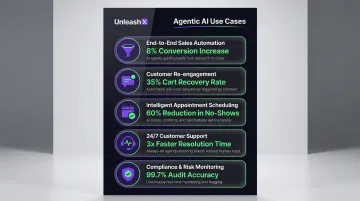
- End-to-end sales workflows - Microsoft's Sales Development Agent achieved an 8-percentage point increase in opportunity conversion across 70,000 SMB customers
- Customer re-engagement - Conversational AI recovers 35% of abandoned carts versus 3-5% for traditional emails
- Candidate sourcing and screening - Neighborly reduced cost-per-hire by 54% and cut interview scheduling from 5 days to 9 minutes
- Dynamic support resolution - 93% of customer questions resolved without human intervention
- Insurance policy workflows - Lead nurturing, quote generation, and renewal outreach with autonomous CRM updates
These results come with an important caveat. RPA delivers 250% ROI for stable, structured tasks, while production-grade AI agents achieve 171% ROI across India (192% in the US) yet only 12% of projects reach production due to governance and inference cost challenges.
Agentic AI vs RPA: Which One Should You Choose?
The right choice comes down to what your process actually looks like how structured your data is, how much judgment the task requires, and how much variability you can tolerate in execution.
Choose RPA when:
- Your process is high-volume, stable, and rule-bound
- Inputs are structured and formats won't change frequently
- Auditability and deterministic execution are priorities
- You need simple back-office automation (payroll, data migration, standard claims)
- Your team can handle ongoing bot maintenance
Choose Agentic AI when:
- Workflows involve unstructured data (emails, PDFs, variable formats)
- Tasks require cross-system coordination and contextual decisions
- You need customer-facing interactions with conversational intelligence
- Processes have dynamic exceptions that require real-time judgment
- You want end-to-end workflow ownership, not just task execution
The Hybrid Approach
Mature enterprises increasingly use both RPA for legacy back-end processes and agentic AI as the orchestration layer. In this model, AI agents "think" while RPA bots "do": the agent interprets unstructured inputs and makes decisions, then triggers RPA workflows to execute secure backend updates. The result is a system that meets compliance requirements without sacrificing adaptability.
That layered architecture reflects a broader shift: 88% of business leaders now view AI and machine learning as essential to successful automation, with most organizations building AI intelligence on top of existing RPA infrastructure rather than replacing it outright.
Real-World Results: Agentic AI in Action
Property Point faced a classic challenge: an old database of leads that weren't being effectively engaged, resulting in lost sales opportunities. Manual follow-ups were slow, inconsistent, and failed to convert dormant prospects.
After deploying UnleashX's voice Sales Development Representative (SDR) technology, Property Point transformed their lead revival process. The agentic AI employee autonomously re-engaged old database leads through voice calls, WhatsApp, and chat understanding prospect context, addressing project-specific questions, and coordinating follow-ups without human intervention.
Measurable outcomes:
- 57% faster customer follow-ups leads contacted within minutes, not days
- 31% higher conversion from old leads prospects who had gone cold for months

CEO Ajit Kadian noted: "The voice SDRs revived our entire old database. People actually responded because the agent sounded natural, helpful and fully aware of our projects. Follow ups became instant. Interest checks became smoother. The sales team finally got real conversations instead of chasing dead ends."
Property Point's results mirror a broader pattern across Indian BFSI, real estate, insurance, and D2C, where WhatsApp-first engagement and Hindi or regional-language conversations make voice-capable agentic AI the default starting point for revenue-driving automation.
These are outcomes rule-based RPA cannot deliver: it has no mechanism for handling unstructured conversations, adapting messaging mid-call, or maintaining context across voice, WhatsApp, and chat simultaneously. That's the practical gap between the two approaches and why the choice matters for revenue-generating workflows.
If your team is still relying on scripted automation for customer-facing or sales workflows, explore how UnleashX AI employees can take over end-to-end go live in 45 minutes.
Conclusion
RPA and agentic AI aren't rivals, they serve different automation needs with distinct strengths. RPA remains the optimal choice for structured, stable, high-volume tasks where deterministic execution and auditability are essential. Agentic AI is the right tool when adaptability, judgment, and end-to-end workflow execution matter particularly in customer-facing operations where context and conversational intelligence drive outcomes.
For teams in sales, support, or HR, the question has shifted from "should we automate?" to "how much can we hand off to AI that actually thinks?" Production deployments are already answering that 171% ROI and measurable conversion lifts show the ceiling is higher than most teams expect.
The most effective enterprise automation strategies don't force a choice between RPA and agentic AI. They run RPA where precision and predictability matter, and deploy agentic AI where judgment, context, and end-to-end execution do the heavy lifting.
For Indian businesses operating across BFSI, IT services, real estate, insurance, and D2C, the hybrid pattern is especially powerful: deterministic RPA for backend compliance with RBI, IRDAI, and DPDP requirements, paired with agentic AI for multilingual, WhatsApp-led customer engagement.
Frequently Asked Questions
What is the difference between agentic AI and robotic process automation?
RPA follows fixed rules to execute structured tasks by mimicking human clicks and keystrokes. Agentic AI perceives context, makes autonomous decisions, and executes complex multi-step workflows across unstructured data, adapting dynamically to exceptions and ambiguity without requiring pre-programmed rules for every scenario.
Which Indian companies are deploying agentic AI alongside RPA?
Major Indian IT services firms including TCS, Infosys, Wipro, and HCLTech operate large RPA practices for pan-India clients while increasingly embedding agentic AI capabilities. NASSCOM has tracked rapid agentic AI adoption across Indian BFSI (HDFC, ICICI, SBI, Axis), insurance, and D2C, where multilingual customer engagement and judgment-driven workflows demand the adaptability that pure RPA cannot deliver.
How are Indian BFSI firms combining agentic AI and RPA for KYC, fraud, and support?
Indian banks pair RPA bots with agentic AI to keep deterministic backend execution (payroll, ledger postings, regulatory filings) on RPA while routing customer-facing flows including KYC verification, fraud triage, claims intake, and Hindi or regional-language support to agentic AI. RBI guidelines on outsourcing and IT governance, plus DPDP 2023 compliance, drive this layered architecture so audit trails remain intact.
Will agentic AI replace RPA jobs in the Indian IT services industry?
Agentic AI is not eliminating RPA roles in India; it is reshaping them. Indian IT services firms are upskilling RPA developers into AI agent designers, prompt engineers, and orchestration architects. NASSCOM and Deloitte India research suggests the workforce shift favours hybrid skill sets: workers who understand both rule-based RPA design and agentic AI orchestration are seeing the strongest demand, while pure repetitive-task roles continue to consolidate.
What are the 4 stages of agentic AI operation?
The four stages are: Perception (gathering inputs from structured and unstructured sources), Reasoning (deciding next action based on goals and context), Action (executing across systems, tools, and channels), and Learning (improving based on results and feedback).
What is the difference between an AI workflow and an AI agent?
An AI workflow is a predefined automation sequence where steps are fixed in advance, even if AI-assisted. An AI agent determines its own steps in real time based on context, goals, and conditions, handling exceptions without human intervention.