
Introduction
A shopper texts an AI assistant: "Find me a waterproof hiking backpack under ₹12,400 (≈ $150), compare the top three options, and order the best-rated one." By the time they finish their coffee, it's done: product researched, options compared, purchase completed. This isn't science fiction. It's agentic commerce, and it's reshaping how people discover, decide, and buy online.
The stakes are significant. McKinsey projects that agentic commerce could orchestrate up to $1 trillion (approximately ₹83.0 lakh crore) in US B2C retail revenue by 2030, $3 trillion (approximately ₹249.0 lakh crore) figures ranging from ₹249 (≈ $3)trillion to ₹415 (≈ $5)trillion. eCommerce businesses that don't adapt risk being bypassed entirely, relegated to the background while AI agents become the primary interface between shoppers and products.
The companies that move first will shape pricing models, agent discovery preferences, and consumer trust norms before competitors set the defaults. This article breaks down what agentic commerce actually is, how it works, and what eCommerce businesses need to do to stay relevant.
Key Takeaways
- Agentic commerce uses AI agents that autonomously search, compare, and complete purchases on a shopper's behalf
- Unlike chatbots, these agents plan, reason, and act across tasks with minimal human input
- Key applications include product discovery, cart recovery, post-purchase automation, and personalized recommendations
- UnleashX's Sarah handles cart recovery 24/7 across voice, WhatsApp, and chat autonomously
- Discovery, loyalty, and customer engagement all need to be rebuilt for an agent-driven world
- Trust, data sovereignty, and clear user permissions are the critical guardrails for safe adoption
What Is Agentic Commerce?
Agentic commerce is shopping powered by AI agents that anticipate consumer needs, navigate product options, negotiate deals, and execute transactions on a user's behalf. Unlike passive recommendation engines that suggest products based on browsing history, agentic AI initiates actions, sets goals, and closes the full loop from discovery to checkout without waiting to be asked.
It's the next step in a clear progression:
- Static websites → Search-driven browsing → Recommendation engines → Conversational AI → Autonomous agents that complete purchases end-to-end
Three Core Interaction Models
McKinsey defines three key interaction models that consumers and merchants will encounter:
Agent-to-site: An AI agent browses a merchant's platform directly to find and purchase matching products (for example, a travel agent scanning hotel websites and booking a room).
Agent-to-agent: A shopper's personal AI agent communicates with a retailer's commerce agent to negotiate bundles or apply discounts autonomously.
Brokered agent-to-site: An intermediary facilitates multi-agent, multi-platform transactions (for example, a restaurant booking agent coordinating through OpenTable's agent layer).
Consumer Adoption Is Already Underway
Consumer behavior is shifting rapidly. According to McKinsey's AI Discovery Survey, 44% of consumers who use AI-powered search now prefer it over traditional search engines for buying decisions. This preference tops traditional search (31%), retailer websites (9%), and review sites (6%).
Platforms are responding to that demand directly:
- OpenAI's Operator (January 2025): A computer-using agent that controls a web browser to autonomously perform tasks like ordering groceries or booking travel
- Perplexity's "Buy with Pro" (November 2024): One-click AI commerce allowing users to check out seamlessly within the chat interface
- Shopify's Universal Commerce Protocol (January 2026): An open standard co-developed with Google allowing AI agents to discover capabilities, negotiate payments, and complete transactions
- Visa's Intelligent Commerce (April 2025): Tokenized digital credentials that let consumers set spending limits and conditions for agent transactions
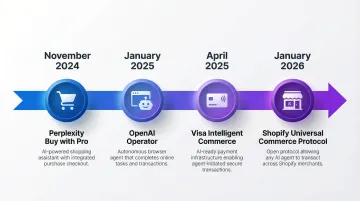
With payments infrastructure, open protocols, and major AI platforms already in place, the architecture for agentic commerce isn't being planned, it's being deployed.
How Agentic Commerce Differs from Traditional eCommerce AI
Traditional recommendation engines and chatbots wait for explicit commands. They respond; they don't act. Agentic AI is different, it initiates actions, sets goals, and adapts dynamically based on context, behaving more like a personal shopping concierge than a search bar.
Three Capabilities That Give Agents Decision-Making Power
- Persistent memory across preferences, sizes, past orders, and contextual signals (calendar events, browsing history, stated goals) lets agents surface relevant products without being asked.
- Live tool access via APIs to product catalogs, payment systems, and fulfillment platforms means agents can query inventory, pricing, and availability in real time.
- Structured reasoning breaks complex requests into actionable steps comparing options, weighing trade-offs, and executing multi-step workflows without manual input.
The Customer Experience Gap
In traditional eCommerce, a shopper browses 6 tabs, reads 14 reviews, compares shipping times manually, and navigates an average checkout flow with 11.3 form fields across 5.1 steps. With an agentic agent, they state intent once and the agent synthesizes all of this in seconds.
That compression of effort has direct consequences for retailers too because if agents are doing the browsing, the product data they encounter must be built for machines, not just humans.
Agent Experience (AX): The New Design Frontier
Designing for AI agents ensuring products are structured, machine-readable, and semantically rich is becoming as critical as traditional UX or SEO. As Cognizant notes, human-centered design accommodates ambiguity, serendipity, and emotional connection, whereas agents operate on principles of logic, utility, and efficiency.
For an agent, the journey is merely a means to an end, requiring precision, completeness, and programmatic clarity. Retailers must optimize product directories for agent readability, develop agent-authenticated interfaces, and expose loyalty services via APIs.
Key Applications of AI Agents in eCommerce
Product Discovery and Personalized Recommendations
Agents interpret contextual signals calendar events, browsing history, stated goals to surface hyper-relevant products proactively, before a shopper even visits a product page. AI-driven personalization increases Average Order Value (AOV) by 26%, and leading companies generate 40% more revenue from personalization activities compared to average performers.
Cart Abandonment Recovery and Checkout Assistance
Pan-India cart abandonment sits at 70.22%, driven largely by friction like lengthy checkout processes, unexpected costs, and forced account creation. Agentic tools can detect when a shopper drops off mid-journey, re-engage them across channels (voice, WhatsApp, chat), guide them through checkout, and send payment links, completing orders that would otherwise be lost.
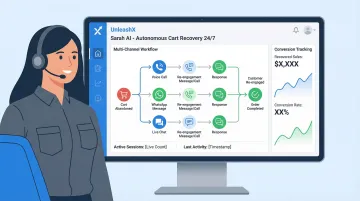
UnleashX's Sarah (Cart Abandonment AI Employee) operates 24/7 across voice, WhatsApp, and chat to recover lost revenue. Sarah autonomously:
- Re-engages dropped customers within hours
- Resolves purchase doubts instantly
- Sends payment links and guides customers through checkout
- Tracks conversion metrics until abandoned carts convert to revenue
Post-Purchase and Subscription Management
Agents can autonomously manage reorders (for example, reordering consumables when stock runs low), track deliveries, process return requests, and negotiate resolutions, all without human intervention. The result is lower operational overhead and faster resolution times for customers.
Dynamic Pricing and Real-Time Negotiation
Agentic systems can assess competitor pricing, customer lifetime value, and real-time inventory to propose optimal prices or negotiate personalized bundle deals on a shopper's behalf. Unlike static promotions, this allows pricing decisions to adapt to each shopper's context in real time.
Cross-Platform and Multi-Merchant Orchestration
Rather than shopping on a single platform, agents can compare products across multiple merchants, assemble the best cart across retailers, and complete a seamless multi-vendor checkout. Shoppers benefit from optimized selection and pricing without manually visiting multiple storefronts.
What This Means for eCommerce Businesses
The AI Agent Is Now Your First Customer
The AI agent is now the first filter a shopper's intent passes through. Businesses need to win over the agent's selection logic like structured data, API-ready product catalogs, and strong review signals before they can win the human shopper's attention.
Ad-Based Discovery Models Are Under Pressure
Traditional ad-based retail media networks and click-driven discovery funnels may decline as agents bypass standard advertising. McKinsey warns that AI agents can detect early intent through contextual signals and proactively assemble shopping plans.
Emerging monetization models businesses should explore include:
- Sponsored contextual placements within agent interfaces
- Multi-brand bundling fees for orchestrated purchases
- Subscription-based agent access for premium services
- Data analytics sales providing insights into agent-driven behavior
Building Loyalty When Agents Handle Reordering
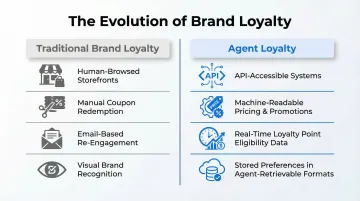
When agents manage replenishment and reordering autonomously, the concept of brand loyalty shifts. Businesses can build "agent loyalty" by:
- Ensuring systems are accessible via APIs
- Offering real-time eligibility data for loyalty points
- Making pricing, availability, and promotions machine-readable
- Storing customer preferences in formats agents can retrieve and act on
Navigating Challenges and Preparing for the Agentic Era
Trust and Safety Guardrails
Agentic commerce introduces new accountability questions: if an agent completes an unauthorized purchase or a return goes wrong, determining responsibility (consumer, AI platform, retailer) remains legally ambiguous.
The UK Competition and Markets Authority issued guidance in March 2026 stating that businesses are responsible for what an AI agent does in the same way they are responsible for an employee. If an AI agent breaks consumer protection law, businesses could face fines of up to 10% of their across India turnover.
Businesses need to build:
- Clear consent frameworks with verified authorization records
- Transaction audit trails providing non-repudiable records
- Human override mechanisms for complex edge cases
- Escalation protocols when agents encounter ambiguous situations
Know Your Agent (KYA) Standards
Traditional fraud detection was built around human behavior, agentic commerce requires "Know Your Agent" (KYA) verification standards. KYA adapts core KYC principles for non-human actors, ensuring every automated action can be traced back to a verified human or corporate entity.
Emerging standards include:
- Google's Agent Payments Protocol (AP2): Uses cryptographically-signed "Mandates" to prove user authorization
- Visa's tokenized AI-ready credentials: Replaces card details with tokenized digital credentials, allowing consumers to set spending limits
- Digital Agent Passports: Tamper-proof identity layers verifying an agent's origin, ownership, and user intent
How to Get Agent-Ready
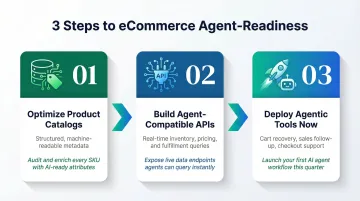
Three foundational moves eCommerce businesses should make now:
1. Optimize product catalogs with structured, machine-readable metadata. Embed semantic and behavioral metadata, develop agent-authenticated interfaces, and expose loyalty services via APIs so agents can accurately discover and represent your products.
2. Build or adopt agent-compatible APIs. Allow autonomous agents to query inventory, pricing, and fulfillment in real time. Prioritize API stability, headless commerce architecture, and programmatic clarity.
3. Deploy agentic tools within guardrails now cart recovery, 24/7 sales follow-up, and checkout support without waiting for full infrastructure overhaul.
For teams starting with step three, UnleashX offers pre-built AI employees for eCommerce sales and cart recovery workflows, deployable in under 45 minutes without complex integrations.
Don't Wait and See
McKinsey's analysis of agentic AI suggests the window for first-mover advantage is open now and narrowing. Early adopters can shape pricing models, agent discovery preferences, and consumer trust norms before competitors set the defaults. Businesses that act first will be negotiating from strength; those that wait will be adapting to rules they had no hand in writing.
Frequently Asked Questions
How are Indian D2C brands using AI agents for sales and support?
Indian D2C brands (Mamaearth, boAt, SUGAR, Plum, Wakefit, MyGlamm) run AI agents on WhatsApp for cart abandonment recovery, order tracking, exchange and return resolution, and festive-season scaling around Diwali, Big Billion Days, and Great Indian Festival. Multilingual support in Hindi and regional languages drives noticeable lift on Tier-2 and Tier-3 conversion.
What is the difference between agentic commerce and agentic AI?
Agentic AI is the broader technology category (AI that reasons, plans, and acts autonomously), while agentic commerce is a specific application of that technology within eCommerce and retail.
What is an example of agentic AI in eCommerce?
An AI agent detects a shopper abandoned their cart, re-engages them via WhatsApp, answers questions about the product, and sends a payment link. UnleashX's Sarah works exactly this way, handling cart recovery 24/7 across voice, WhatsApp, and chat.
How does Indian GST affect AI commerce automation?
GST e-invoicing, IRN generation, and inter-state tax handling can be automated end-to-end. AI agents can issue compliant invoices on order confirmation, handle ITC reconciliation, manage return-related credit notes, and surface GST-relevant fields in customer queries. Indian D2C brands using these flows typically report fewer billing disputes and faster reconciliation cycles.
What Indian payment and channel preferences should AI commerce stacks support?
UPI dominates checkout (PhonePe, Google Pay, Paytm), followed by COD which still drives 40-60% of Tier-2/3 orders. WhatsApp is the primary post-purchase channel. AI agents should handle UPI failure recovery, COD verification calls in regional languages, WhatsApp order updates, and Hindi voice IVR for high-ticket or COD orders to reduce return-to-origin rates.
What is the best AI for e-commerce?
For cart recovery and sales automation, full-stack AI employees like UnleashX's Sarah, operating 24/7 across voice, chat, and WhatsApp that deliver measurable conversion impact. For broader infrastructure needs, platforms like Shopify's agentic tools or Salesforce Agentforce are also emerging options. The right fit depends on your use case and scale.