Introduction
Cart abandonment is a structural problem for Indian e-commerce. Rates across India sit around 70%, and for a D2C brand processing ₹100 crore annually, that translates to roughly ₹70 crore of recoverable revenue every year. Slow response times, after-hours drop-offs, and limited multilingual support sit at the centre of the problem — and they cost online retailers across India real revenue, every day.
By 2026, AI voice assistants have become the operational fix. They execute complete shopping journeys — product discovery, cart recovery, order tracking, and post-purchase follow-ups — autonomously across voice, chat, and messaging channels including WhatsApp, around the clock.
India's voice-commerce market is on a sharp growth curve. Industry analysts project robust double-digit CAGR through the decade as Hindi, Tamil, Bangla, and other regional vernacular voice usage drives mainstream adoption across Tier-2 and Tier-3 cities. The window to deploy these tools ahead of competitors is now.
This guide breaks down the top AI-powered voice assistants for Indian e-commerce in 2026 — what they do, how they compare, and which capabilities to prioritise when evaluating your options for D2C and online retail operations.
Key Takeaways
- AI voice assistants for Indian e-commerce handle sales outreach, cart recovery, order tracking, and post-purchase follow-ups autonomously across voice, WhatsApp, and chat
- Top platforms combine sub-700ms latency, Hindi and regional language support, and deep CRM integrations — delivering up to 2.5x conversion gains
- Accuracy, channel coverage (voice, chat, WhatsApp), CRM sync, deployment speed, and UPI/COD-aware flows determine which tool fits Indian operations
- UnleashX, Amazon Alexa, Google Dialogflow CX, Voiceflow, and Synthflow AI are the leading platforms for Indian e-commerce in 2026
What Are AI-Powered Voice Assistants for E-Commerce?
AI-powered voice assistants for e-commerce are natural language processing (NLP)-driven agents capable of understanding customer intent, handling product queries, processing orders, and recovering lost revenue through voice, chat, and messaging channels. Unlike general-purpose assistants, these tools are built specifically for shopping workflows — cart recovery, payment link delivery, order status inquiries, and post-purchase upselling — with channel coverage that fits how Indian shoppers actually buy.
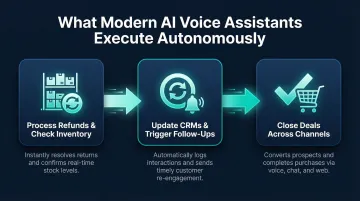
The evolution from rule-based scripts to autonomous agents has been swift. Modern AI voice assistants now leverage Large Language Models, Retrieval-Augmented Generation, and tool-calling capabilities to take real actions:
- Process refunds and check live inventory
- Update CRMs and trigger follow-up sequences across WhatsApp, voice, and email
- Close deals across voice, chat, and messaging without human intervention
Industry data suggests over two-thirds of customer conversations are now handled end-to-end by AI, reflecting how production-ready these systems have become for Indian D2C and e-commerce brands.
The platforms compared below were evaluated on workflow depth, channel coverage, and real-world deployment readiness — the factors that separate capable tools from genuinely autonomous ones for Indian e-commerce operations.
Top AI-Powered Voice Assistants for E-Commerce in 2026
Each tool below was shortlisted on five criteria: e-commerce relevance, conversational accuracy, integration depth, omnichannel coverage (including WhatsApp), and deployment speed — the factors that actually determine whether a voice AI delivers ROI for Indian D2C brands or just adds complexity.
UnleashX (Sarah - Cart Abandonment AI & Peter - Sales AI)
UnleashX is a full-stack AI employee platform built for Indian e-commerce and high-volume operations, offering purpose-built AI employees like Sarah (cart abandonment recovery via voice, WhatsApp, and chat) and Peter (sales outreach across calls, chat, and email with autonomous CRM updates).
Unlike general-purpose voice bots, UnleashX deploys as fully autonomous AI employees — each purpose-built for a specific workflow. For Indian D2C and e-commerce brands managing scale, that distinction matters: the same platform that re-engages a cart abandoner in Hindi can follow up a lead in Tamil or Bangla, with no custom development required.
| Category | Details |
|---|---|
| Key Features | Autonomous cart recovery, proactive sales outreach, multilingual voice + chat + WhatsApp, 24/7 operation, CRM sync, human-in-loop oversight |
| E-Commerce Use Cases | Cart abandonment re-engagement, lead conversion, payment link delivery, order follow-ups, post-purchase upsell |
| Deployment & Performance | 45-min go-live, <700ms latency, 99% uptime, 98% accuracy, 2.5x reported lead conversion improvement |
The 45-minute go-live is a genuine differentiator for Indian e-commerce teams that can't afford weeks-long implementation cycles — particularly during peak Diwali, Big Billion Days, and Great Indian Festival sale periods.
Amazon Alexa (Alexa Shopping & Alexa for Business)
Amazon Alexa is widely adopted across India for voice-driven commerce, deeply embedded in the Amazon ecosystem with native shopping capabilities for Prime members and developer tools (Alexa Skills Kit) for custom e-commerce experiences.
Alexa's core advantage is consumer familiarity and direct access to Amazon's logistics and payment rails — putting your product in front of customers who are already in a buying context. The tradeoff: custom skill development requires engineering resources, and certification typically takes at least five business days.
| Category | Details |
|---|---|
| Key Features | Voice-enabled product search, one-click reorder, smart home integration, Alexa Skills Kit for custom builds |
| E-Commerce Use Cases | Reorder automation, product discovery, Amazon storefront voice navigation, flash deal alerts |
| Deployment & Performance | Available to Indian Prime members and developers via Alexa Skills Kit; skill certification typically requires 5+ business days; localisation supported across Indian English and Hindi variants |
The Alexa Shopping Actions API allows third-party developers to embed shopping workflows within custom skills, including "Add to list," "Buy products," and "Recommend products" actions for Indian storefronts.
Google Dialogflow CX
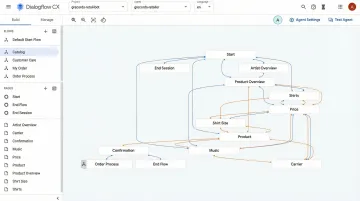
Google Dialogflow CX is an enterprise-grade conversational AI platform for e-commerce brands building sophisticated voice and chat agents. It combines advanced intent recognition and state-based conversation flows with Google Cloud infrastructure, with availability across Indian GCP regions.
Native Google Cloud integration means omnichannel deployment across phone, web, and mobile out of the box — with conversation analytics built in. Best suited for mid-to-large Indian e-commerce operations that have developer resources available, given the 3–6 month enterprise deployment window.
| Category | Details |
|---|---|
| Key Features | Visual flow builder, multi-turn conversations, NLU engine, webhook integrations, sentiment analysis |
| E-Commerce Use Cases | Customer support automation, product recommendation flows, order status inquiries, returns handling |
| Deployment & Performance | 3–6 months for enterprise deployment; 80+ languages supported including Hindi, Tamil, and Bangla; usage-based pricing approximately ₹0.6 (≈ $0.007) per chat request and ₹0.08 (≈ $0.001) per voice second for deterministic flows |
A major Indian e-commerce retailer deployed a Big Billion Days chatbot and order-tracking IVR via Dialogflow, resulting in a 60% increase in call centre efficiency. Leading Indian online retailers use Vertex AI — the infrastructure underlying Dialogflow — to power generative AI product discovery and review summarisation.
Voiceflow
Voiceflow is a no-code/low-code AI agent builder popular among e-commerce teams for designing and deploying voice and chat assistants without writing code. Used by brands to build product navigation bots, FAQ agents, and guided checkout experiences.
The visual drag-and-drop canvas, built-in team collaboration, and native Shopify integrations make it a strong pick for lean Indian e-commerce teams prioritising launch speed. The tradeoff versus enterprise platforms is customisation ceiling — Voiceflow excels at standard flows, less so at complex multi-system orchestration.
| Category | Details |
|---|---|
| Key Features | No-code flow builder, multi-channel deployment, Shopify integration, team collaboration, API connectors |
| E-Commerce Use Cases | Product navigation, FAQ deflection, guided checkout, post-purchase support flows |
| Deployment & Performance | 130,000+ active users worldwide, 450 enterprise customers including Amazon; pricing approximately ₹5,000 (≈ $60) per editor per month (Pro) to ₹12,500 (≈ $150) per editor per month (Business); supports text, voice, Twilio (SMS/Voice), and WhatsApp |
Voiceflow raised approximately ₹124.5 crore (≈ $15 million) in August 2023, bringing total funding to approximately ₹290.5 crore (≈ $35 million) at a ₹871.5 crore (≈ $105 million) valuation — a sign of growing enterprise demand for no-code agent tooling that Indian e-commerce teams are increasingly adopting.
Synthflow AI
Synthflow AI is a conversational voice AI platform focused on automating inbound and outbound sales calls, with a strong use case fit for Indian e-commerce brands running tele-sales, lead qualification, and post-purchase voice follow-up campaigns.
Human-like voice quality, no-code agent configuration, and native integrations with HubSpot, Salesforce, and GoHighLevel mean Indian e-commerce brands can scale outbound voice engagement without scaling headcount. At sub-600ms latency with the low-latency edge add-on, conversations feel natural rather than robotic.
| Category | Details |
|---|---|
| Key Features | Inbound/outbound call automation, human-like TTS, CRM integrations, real-time call routing, conversation analytics |
| E-Commerce Use Cases | Abandoned order outreach, post-purchase upsell calls, customer reactivation, sales qualification |
| Deployment & Performance | 250–400ms average response speed; <600ms latency with low-latency edge add-on; pricing approximately ₹31,500 (≈ $375) per month (Pro, 2,000 minutes) to ₹1.05 lakh (≈ $1,250) per month (Agency, 6,000 minutes); integrates with HubSpot, Salesforce, GoHighLevel, Stripe, WhatsApp, Twilio |
Synthflow AI agents have saved over 5 million hours of contact centre operations, answered 35% more calls compared to non-AI operators, and handled 45 million calls with 99.9% uptime.
How We Chose the Best AI Voice Assistants for E-Commerce
Most Indian e-commerce teams make the mistake of choosing voice tools based on demo performance or brand name alone, without testing how the tool handles real workflows — like abandoned cart recovery, multilingual support across Hindi and regional languages, or CRM sync under live conditions.
Core selection factors used:
- Understands customer intent across diverse queries and handles multi-turn conversations without breaking context
- Covers voice, chat, WhatsApp, and email — not just a single channel
- Syncs natively with Shopify, WooCommerce, HubSpot, or Salesforce without custom API work
- Goes live in days, not months
- Supports regional Indian languages like Hindi, Tamil, Bangla, and other vernaculars — not just English
- Responds in under 600ms (delays over 1,500ms trigger abandonment)
- Offers clear, predictable pricing — not just "contact us for a quote"
- Backs claims with real outcome data: conversion lifts, cart recovery rates, response time reductions
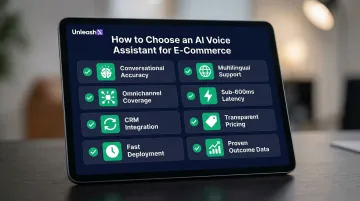
Latency is where most vendors cut corners. Human conversation relies on a 200–300ms response gap; voice AI under 600ms feels natural, while anything over 1,500ms triggers neurological stress and abandonment. Shoppers complete purchases 47% faster when assisted by AI, and proactive engagement recovers up to 35% of abandoned carts.
Multilingual support is equally non-negotiable for Indian e-commerce. 76% of online shoppers prefer buying in their native language, and 40% won't purchase from a site that doesn't offer it. Indian stores that add Hindi and regional language support see conversion rates climb by up to 20%.
The right voice AI assistant should directly influence revenue metrics — conversion rates, cart recovery rates, response times — not just deflect support tickets.
Conclusion
AI-powered voice assistants for Indian e-commerce in 2026 now execute autonomous, revenue-generating workflows across the full customer lifecycle — from first touchpoint through cart recovery to post-purchase follow-up. AI chatbots with behavioural triggers recover 20–35% of abandoned carts, versus 10–15% for live chat alone. They also cost roughly 12x less per interaction (approximately ₹40 vs ₹500 for human customer service).
When choosing from the platforms reviewed here — UnleashX, Amazon Alexa, Google Dialogflow CX, Voiceflow, and Synthflow AI — evaluate beyond feature lists. The factors that separate viable solutions from short-lived experiments include:
- Time-to-value: How quickly can you go live and see measurable results?
- Integration fit: Does it connect with your existing CRM, payment (UPI, Razorpay, PayU), and fulfilment stack?
- Language and channel coverage: Can it scale across Hindi, Tamil, Bangla, and other Indian languages — and across WhatsApp, voice, and chat?
- Workflow depth: Does it handle end-to-end execution, or just respond to queries?
UnleashX's AI employees like Sarah and Peter are deployable in under 45 minutes and built specifically for Indian e-commerce revenue workflows. Contact the team via WhatsApp at +919911997433 to explore a demo or see how it fits your operations.
Frequently Asked Questions
How are Indian D2C brands using AI agents for sales and support?
Indian D2C brands (Mamaearth, boAt, SUGAR, Plum, Wakefit, MyGlamm) run AI agents on WhatsApp for cart abandonment recovery, order tracking, exchange and return resolution, and festive-season scaling around Diwali, Big Billion Days, and Great Indian Festival. Multilingual support in Hindi and regional languages drives noticeable lift on Tier-2 and Tier-3 conversion.
How does Indian GST affect AI commerce automation?
GST e-invoicing, IRN generation, and inter-state tax handling can be automated end-to-end. AI agents can issue compliant invoices on order confirmation, handle ITC reconciliation, manage return-related credit notes, and surface GST-relevant fields in customer queries. Indian D2C brands using these flows typically report fewer billing disputes and faster reconciliation cycles.
How does a voice AI assistant help reduce cart abandonment?
Voice AI assistants re-engage shoppers who dropped off by proactively reaching out via call, WhatsApp, or chat. They remind customers of their cart, resolve objections in real time, and send payment links to complete the purchase, recovering 20-35% of abandoned carts.
What features should I look for in an AI voice assistant for my online store?
Prioritise these when evaluating platforms for Indian e-commerce:
- Low latency (under 700ms for natural conversations)
- Multilingual support and omnichannel coverage (voice, chat, WhatsApp)
- CRM integration and fast deployment
- UPI / COD / payment-link aware flows
- Proven impact on conversion rates and response times
Can AI voice assistants support multilingual e-commerce customers?
Yes. Advanced platforms support 50–100+ languages, with some like UnleashX specifically covering 12+ Indian languages including Hindi, Tamil, and Bangla. This makes them viable for regional and pan-India e-commerce brands serving diverse audiences.
What Indian payment and channel preferences should AI commerce stacks support?
UPI dominates checkout (PhonePe, Google Pay, Paytm), followed by COD which still drives 40-60% of Tier-2/3 orders. WhatsApp is the primary post-purchase channel. AI agents should handle UPI failure recovery, COD verification calls in regional languages, WhatsApp order updates, and Hindi voice IVR for high-ticket or COD orders to reduce return-to-origin rates.
Want to see how UnleashX AI Employees can transform your business? Visit UnleashX to explore the full platform and book a personalized demo.