
Introduction
Businesses today face a critical decision: stick with live call center representatives or embrace AI voice agents. Get this choice wrong, and the consequences ripple through your cost structure, customer satisfaction, and competitive positioning.
Three forces make this decision urgent right now:
- Rising labor costs: Contact center turnover has hit 31.2% annually, with each replacement costing ₹8.3 lakh (≈ $10,000)–₹16.6 lakh (≈ $20,000)once you factor in recruitment and a standard 90-day productivity ramp
- Shifting customer expectations: 24/7 availability has become the baseline, making traditional shift-based coverage no longer adequate for most operations
- Maturing AI: Modern voice agents bear little resemblance to the robotic phone trees of the past
91% of customer service leaders now face executive pressure to implement AI, marking a sharp increase in urgency for AI-enabled transformation. The pan-India call center AI market is projected to grow at 21.3% annually, from $1.6 billion (approximat$4.1 billion (approximately ₹34,000 crore)crore) in 2022 to ₹34,030 crore (≈ $4.1 billion) by 2027. This guide breaks down where each option delivers real value, where it falls short, and what most comparisons get wrong.
Key Takeaways
- AI voice agents offer 24/7 availability, lower costs, instant scalability, and consistent performance with one real limitation: emotionally complex conversations
- Live reps excel at empathy, adaptability, and nuanced judgment, though high costs, attrition, and limited hours create operational ceilings
- The right choice depends on call volume, complexity, industry requirements, and customer expectations neither is universally better
- Hybrid models AI for routine interactions, humans for exceptions deliver the strongest ROI and customer satisfaction
- UnleashX AI employees go beyond call handling: they autonomously run full workflows across voice, chat, email, and CRM systems
AI Voice Agents vs. Live Call Center Reps: Quick Comparison
Cost
| AI Voice Agents | Live Reps | |
|---|---|---|
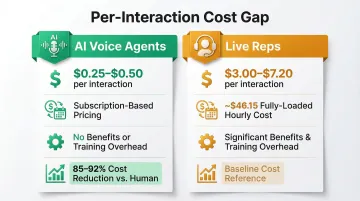
| Cost per interaction | ₹21 (≈ $0.25)– ₹42 (≈ $0.50) | ₹249 (≈ $3.00)– ₹598 (≈ $7.20) |
| Hourly equivalent | Subscription-based | ~₹3,800 (≈ $46.15)fully-loaded |
| Benefits / training overhead | None | Significant |
| Cost reduction potential | 85% – 92% vs. human | Baseline |
AI agents run on setup or subscription fees with no benefits, training, or attrition costs. The average inbound call cost hit ₹598 (≈ $7.20)in 2024, making the per-interaction gap hard to ignore at scale.
Availability
AI Voice Agents: True 24/7 operation with no breaks, shift limits, or holidays. Modern platforms maintain 99% uptime, keeping every channel live without additional staffing.
Live Reps: Constrained by shifts, time zones, and staffing levels. After-hours coverage requires additional cost and coordination, with the standard 90-day ramp time for new agents creating coverage gaps during turnover.
Scalability
AI Voice Agents: Handle thousands of simultaneous calls instantly, no hiring cycle required. AI agents can make 100 to 1,000+ calls per hour 30 to 50 times the throughput of a single rep.
Live Reps: Scaling means recruiting, onboarding, and training, a process that takes weeks or months. At 31.2% annual turnover, maintaining consistent capacity is a continuous effort, not a one-time fix.
Emotional Intelligence
AI Voice Agents: Handle scripted empathy well tone recognition, adaptive responses, calm delivery. Where they fall short is the genuinely unpredictable call: a grieving customer, a furious dispute, a situation no training data anticipated.
Live Reps: Read tone, improvise, and de-escalate in ways no script can pre-program. When frustration runs high or a high-value decision hangs in the balance, human judgment still holds the edge.
Consistency
AI Voice Agents: Follows the same script, tone, and compliance requirements on every call. 100% call recording and real-time monitoring eliminate variance entirely.
Live Reps: Performance varies by agent, fatigue, mood, and experience level. Estimated performance variance runs 15% to 30%, yet most contact centers review only 1 to 2 calls per agent each week meaning most variance goes undetected.
What Are AI Voice Agents?
AI voice agents are software-driven systems that use natural language processing (NLP) and large language models (LLMs) to conduct spoken conversations with customers handling inbound queries, outbound outreach, appointment setting, lead qualification, and more without human intervention.
Modern AI voice agents are not the rigid IVR systems of the past. While legacy Interactive Voice Response relied on pre-scripted menus and keypad inputs, modern AI voice agents interpret intent dynamically, retrieve contextual data, and generate accurate, human-like responses. The result is a contact center that resolves complete call flows autonomously, not just routes them.
Core Operational Capabilities
Today's AI voice agents deliver:
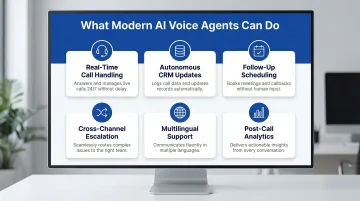
- Real-time call handling with multi-turn context memory across entire sessions
- Autonomous CRM updates that eliminate manual data entry
- Follow-up scheduling across voice, chat, email, and messaging platforms
- Cross-channel escalation routing complex cases to human agents when needed
- Multilingual support at scale major cloud providers now support 40+ language locales
- Post-call analytics providing insights into customer intent, sentiment, and resolution patterns
Performance Advantages
These capabilities translate directly into measurable gains. Deployments using generative AI for caller authentication and post-call summarization have reduced Average Handle Time (AHT) by up to 33%. AI responds instantly to inbound leads without queue times, and responding within the first minute dramatically increases conversion likelihood.
Platforms like UnleashX take this further with full-stack AI employees Peter for sales, Sarah for cart abandonment recovery that combine voice, chat, email, and CRM orchestration in a single agent.
These AI employees autonomously manage complete business processes from initial customer contact through deal closure, keeping CRM records synchronized at every step.
Use Cases of AI Voice Agents
High-volume repetitive interactions are a natural fit. Inbound FAQ handling, order status updates, payment reminders, and appointment confirmations all prioritize speed and consistency over flexibility. 50% to 60% of customer interactions remain highly transactional, making them strong candidates for AI automation.
**Outbound sales and lead nurturing** is where AI agents produce some of their strongest ROI. They execute follow-up call sequences, qualify prospects, and update CRMs without manual involvement,a clear advantage for insurance, banking, automotive, and e-commerce teams managing large lead databases.
What Are Live Call Center Reps?
Live call center reps are trained human agents who handle customer calls, support tickets, or sales interactions bringing interpersonal judgment, improvisation, and real empathy to each conversation.
Human agents maintain a clear edge in high-stakes or emotionally sensitive calls: complaints, disputes, medical queries, large financial decisions. These scenarios require relationship-building and improvisation that falls outside any scripted workflow. When customers are frustrated, confused, or making decisions worth thousands of dollars, human judgment changes outcomes.
The Operational Reality
Those strengths come at a cost. In the US, the Bureau of Labor Statistics reports a median hourly wage of ₹1,700 (≈ $20.59)for Customer Service Representatives but total employer compensation averages ₹3,800 (≈ $46.15)per hour once benefits are included.
Turnover compounds the expense. Contact center attrition is projected at 31.2% annually, with replacement costs running between ₹8.3 lakh (≈ $10,000)and ₹16.6 lakh (≈ $20,000)per agent when you factor in recruitment, onboarding, and lost productivity.
New agents require an average of 90 days to reach full productivity. During this ramp period, they handle fewer calls per hour, experience higher escalation rates, and generate lower customer satisfaction scores.
Use Cases of Live Call Center Reps
Human agents consistently outperform AI in two specific scenarios:
- Complex escalations: 84.7% of consumers prefer a human agent for high-stakes or emotionally charged issues where ambiguity and judgment determine the outcome
- Consultative sales and account management: Enterprise B2B deals, private banking, healthcare, and legal services contexts where long-term trust is the product and empathy drives satisfaction scores
AI Voice Agents vs. Live Call Center Reps: Which One Should You Choose?
The decision hinges on four key variables: call volume and complexity, customer emotion level, budget constraints, and whether your goal is cost efficiency or relationship depth. No single answer fits every business.
Situational Decision Criteria
Choose AI voice agents when:
- You need 24/7 coverage without shift constraints
- You handle high volumes of routine interactions (order status, appointment confirmations, payment reminders)
- You want consistent compliance adherence across every interaction
- You need to scale rapidly without growing headcount
- Your industry requires 100% call recording and audit trails
Choose live reps when:
- Calls are emotionally charged or require de-escalation
- Interactions are highly unpredictable with variables outside any workflow
- High-value decisions require human judgment that changes outcomes
- Your industry demands relationship-building over transaction efficiency
- Customers explicitly request human assistance
The Hybrid Model: Best of Both Approaches
The most effective approach combines both. AI handles the volume first-contact resolution, qualification, follow-ups while human agents are reserved for exceptions and escalations. This combination drives cost efficiency and customer satisfaction at once.
Gartner notes that nearly 80% of organizations plan to transition agents into new roles, redesigning service models so AI handles routine tasks while humans provide context, empathy, and judgment. Industry research broadly confirms that hybrid models produce the strongest outcomes by allocating each call type to the tier best equipped to resolve it.
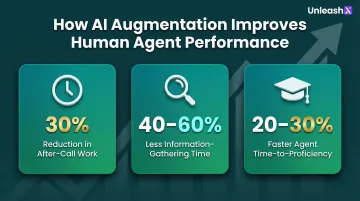
When AI assists human agents, productivity metrics improve across the board:
- AI call summarization cuts After-Call Work by 30%
- Real-time knowledge surfacing reduces information-gathering time by 40–60%
- Simulation-led onboarding shortens agent time-to-proficiency by 20–30%
Addressing the "Replacing vs. Augmenting" Debate
AI voice agents are not simply replacing humans but redefining roles. Reps freed from repetitive calls can focus on complex, high-value interactions, which raises individual productivity and overall team output. The shift isn't about elimination, it's about moving human effort up the value chain, toward judgment, empathy, and relationship work that AI cannot replicate.
Compliance and Quality Control as a Differentiator
Industries like insurance (IRDAI), finance (GDPR), and healthcare benefit from AI's 100% call recording, real-time compliance monitoring, and consistent script adherence.
Manual QA has real limits: 72% of contact centers select calls randomly, reviewing only 1–2 calls per agent each week. AI enables 100% call monitoring and perfect script adherence though it must operate within strict regulatory frameworks, including TCPA requirements for prior express consent on outbound calls.
Real-World Results: When AI Agents Deliver ROI
Property Point faced a common challenge: their sales team was chasing dead ends with an aging lead database. Follow-ups were slow, and old leads weren't converting. After deploying UnleashX's voice AI employees, the impact on their pipeline was immediate.
The results:
- 57% faster customer follow-ups through instant, automated engagement
- 31% higher conversion from old leads that were previously considered dormant
CEO Ajit Kadian explained: "The voice SDRs revived our entire old database. People actually responded because the agent sounded natural, helpful and fully aware of our projects. Follow ups became instant. Interest checks became smoother. The sales team finally got real conversations instead of chasing dead ends."
A different use case, the same pattern: Blu Parrot deployed AI employees to handle routine client communications freeing their team for strategic work and recorded 46% faster client responses and 33% improved campaign efficiency.
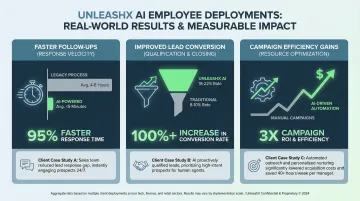
Across both cases, the pattern is consistent: high-volume, rules-based interactions handled by AI freed human teams to focus where their judgment actually matters. The ROI is measurable and arrives quickly once the right workflows are identified.
Explore whether AI employees could fill similar gaps in your operation. Contact UnleashX to discuss your specific use case.
Frequently Asked Questions
How do AI voice agents handle Hindi and regional languages for Indian customers?
Modern voice AI platforms support natural conversations in Hindi, Tamil, Telugu, Kannada, Marathi, Bengali, and code-mixed Hinglish. UnleashX voice agents detect caller language automatically, switch mid-call where needed, and integrate with WhatsApp for follow-ups, which matches how Indian buyers in BFSI, real estate, and D2C actually engage.
What is the 80/20 rule in call centers?
It has two meanings. Operationally, it's the service level standard: answer 80% of inbound calls within 20 seconds. Analytically, it's the Pareto principle: roughly 80% of call volume comes from 20% of issue types, making that majority ideal for AI automation while human reps handle the complex remainder.
What are the main disadvantages of AI voice agents?
AI voice agents struggle with emotionally charged or highly unpredictable conversations, can frustrate customers when they fail to understand context, and require upfront investment for setup and integration. They work best for scripted scenarios with clear resolution paths, but fall short when improvisation, empathy, or nuanced judgment determines the outcome.
Which Indian companies are deploying AI voice agents in production?
Indian BFSI majors (HDFC, ICICI, SBI, Axis), real estate firms, lending NBFCs, and D2C brands are running voice AI in production for sales calls, KYC follow-ups, and customer support. NASSCOM has tracked rapid adoption across IT services and BPO firms (TCS, Infosys, Wipro, HCLTech) building voice AI practices for Indian and pan-India enterprise clients.
What Indian regulations should I consider before deploying voice AI?
DPDP 2023 governs personal data handling in voice interactions, including consent capture and audit trails. RBI guidelines on outsourcing apply to BFSI deployments, IRDAI rules cover insurance workflows, and TRAI's commercial communication rules govern outbound calling. Production-grade voice AI platforms maintain call recordings, language logs, and consent receipts to meet these requirements.
What types of calls should always be handled by a live agent?
Legal disputes, medical emergencies, complex financial complaints, customers explicitly requesting a human, and any call requiring documented regulatory judgment should go to live agents. These are scenarios where empathy, improvisation, and relationship-building directly determine the outcome.