
Introduction
Sales teams lose 10-11 hours per week to manual CRM data entry after calls. Support teams ask customers to repeat information across every interaction, 74% of consumers find this frustrating. Follow-ups fall through the cracks not from lack of effort, but from broken tooling between voice and data.
The real value of AI voice assistants only surfaces when they are deeply integrated with CRM systems acting as an active participant in the customer data lifecycle, not a disconnected add-on. Without that integration, 91% of CRM data remains incomplete, and teams waste time reconstructing context that should already exist.
This article covers three measurable advantages AI voice-CRM integration delivers, what goes wrong without it, and how to get the most out of it in practice.
Key Takeaways
- AI voice-CRM integration connects voice interactions directly to your system of record, enabling real-time data capture and action without manual input
- Three core advantages: real-time CRM accuracy, personalized outreach at volume, and autonomous workflow execution beyond basic call logging
- Without integration, businesses absorb compounding costs from data lag, missed follow-ups, and broken customer experiences
- High call-volume industries like insurance, banking, automotive, e-commerce gain the most from this integration
- Teams tracking adoption against clear KPIs consistently report faster follow-ups and higher conversion rates
What Is AI Voice Assistant CRM Integration?
AI voice assistant CRM integration is the direct, real-time connection between voice-based AI interactions like calls, voice commands, conversational exchanges and a CRM platform. It allows customer data to be pulled, updated, and triggered during or immediately after the voice interaction, without human data entry.
Where it's applied:
- Inbound support calls
- Outbound sales calls
- Lead qualification workflows
- Appointment scheduling
- Post-call follow-up automation
- Field sales updates
The core purpose is closing the gap between what happens in a conversation and what gets recorded, acted on, and used to drive the next interaction. By the time a sales rep hangs up, the CRM should already reflect the outcome and the next support agent should inherit full context without asking the customer to repeat themselves.
Key Advantages of AI Voice Assistants in CRM
The three advantages below are operational, not theoretical. Each maps directly to metrics businesses measure: data quality, conversion rates, cost per interaction, and response speed. They also build on each other: accurate data enables personalization, and personalization only scales when workflows run autonomously.
Real-Time CRM Data Accuracy and Elimination of Manual Entry
AI voice assistants capture, transcribe, and structure conversation data caller intent, key details, outcomes, next steps and write it directly into CRM fields in real time, without the rep typing a single word post-call.
During a call, the AI identifies the customer via voice or phone number, retrieves their CRM record, listens to the conversation, extracts relevant updates (objection raised, follow-up date agreed, deal stage changed), and logs them instantly often before the call even ends.
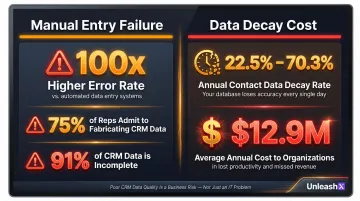
Manual CRM entry is error-prone and time-delayed. Reps skip or abbreviate notes when busy, creating data gaps that compound into poor forecasting and missed context. Human error rates are roughly 100x higher than automated systems, which achieve 99% accuracy. Worse, 75% of reps admit to fabricating CRM data to appease management.
Real-time capture means everyone who touches that account next rep, support agent, or AI works from complete, current information. That directly cuts the cost of repeated customer questions and miscommunication.
KPIs this improves:
- CRM data completeness and accuracy rate
- Time spent on post-call admin
- Cost per qualified lead
- Customer satisfaction (CSAT) from not being asked to repeat information
This matters most in high call-volume environments: insurance sales floors, banking contact centers, e-commerce support teams handling 30–80 calls per day where accurate manual logging is structurally impossible. B2B contact data decays at 22.5% to 70.3% annually, costing organizations an average of $12.9 million (approximately ₹107.1 crore) per year.
Hyper-Personalized Customer Engagement at Scale
Because the AI voice assistant connects to the CRM before the call begins, it arrives at every interaction already knowing the customer's history, preferences, and current stage in the journey enabling personalized conversations from the first second, regardless of call volume.
When a customer calls, the AI pulls their CRM record in under a second and tailors its greeting and response path to match their context. A customer who abandoned a cart yesterday gets a different opening than a first-time caller. No one repeats themselves; the AI already knows.
Personalization at scale has historically been impossible with human agents. A rep can know a regular customer, but not 300 of them. AI voice removes that ceiling. Personalization drives a 10–15% revenue lift, and 71% of brands that excel at personalization report improved customer loyalty.
The CRM becomes a live personalization engine rather than a static archive. Every interaction draws on the full customer history, improving resolution quality and cutting escalation rates.
KPIs this improves:
- First call resolution (FCR) rate
- Lead conversion rate
- Customer retention rate
- Net Promoter Score (NPS)
- Average handle time (AHT)
This matters most for businesses with large customer databases and repeat-contact patterns: subscription services, insurance renewals, e-commerce re-engagement, banking. The average FCR across industries is 69%, ranging from 43% to 88%, and every 1% improvement can save a typical midsize call center ₹2.4 crore (≈ $286,000)annually.
Autonomous Workflow Execution That Goes Beyond Call Logging
The highest-value shift happens when AI voice assistants don't just log what happened they execute what comes next. That means automatically scheduling follow-ups, sending payment links, triggering re-engagement sequences, qualifying leads in real time, and updating deal stages, all within the same interaction.
After a sales call, the AI has already done what a rep would otherwise spend 10–15 minutes on: opened the CRM, created a task, drafted a follow-up email, and updated the pipeline all during or right after the call.
UnleashX's Peter (Sales AI Employee) works this way across calls, chat, and email: connecting with prospects, nurturing leads, sending follow-ups, and updating the CRM 24/7 until every opportunity converts.
Sales reps spend 71% of their time on non-selling tasks, including CRM updates, follow-up emails, and scheduling. The average rep loses 14 out of 51 hours per week to admin. Autonomous execution eliminates that drag entirely, compressing the sales cycle and recapturing selling time.
Re-engagement follows the same logic. When a customer drops off, the AI automatically triggers a voice or messaging workflow guided by CRM data on where they exited. Companies that contact leads within 5 minutes are 100x more likely to connect and 21x more likely to qualify compared to waiting 30 minutes.

KPIs this improves:
- Lead response time
- Follow-up completion rate
- Sales cycle length
- Pipeline velocity
- Cart recovery rate
- Customer follow-up speed
This matters most for sales teams managing large pipelines, e-commerce businesses facing high cart abandonment (70.22% average rate), and any operation where follow-up timing drives conversion. Automated systems achieve 99% follow-up consistency versus 60–70% for manual processes.
What Happens When AI Voice-CRM Integration Is Missing or Ignored
Without this integration, every voice interaction creates a data debt: call details that never reach the CRM, or arrive days later with no context. Reps call the same customer twice about the same issue. Support agents ask customers to repeat themselves. Sales managers forecast from incomplete pipeline data.
Operational failure modes:
- Inconsistent CX: 73% of consumers will switch to a competitor after multiple bad experiences, and 74% find it frustrating to repeat their story both outcomes that follow directly from unlogged voice interactions.
- Rising costs: 44% of organizations lose over 10% in annual revenue due to low-quality CRM data, and missing call context drives unnecessary escalations that increase cost per resolution.
- Scaling bottleneck: Agents spend 6%–12% of their shift on after-call work; at high call volumes, manual CRM entry forces a trade-off between speed and accuracy that neither the team nor the customer can afford.
How to Get the Most Value from AI Voice CRM Integration
Voice-CRM integration only delivers on its promise when applied consistently across every voice interaction, not just selected ones. Partial deployment creates data gaps that break personalization and kill the workflow automation you built it for.
Requirements for full integration:
The AI must be:
- Connected to live CRM data (not batch-updated)
- Given write permissions to update records during interactions
- Configured to trigger downstream workflows (follow-ups, notifications, stage changes) automatically not just transcribe and log
Where to start:
Look for platforms that offer cross-system sync across CRMs, APIs, and external tools with minimal setup time. UnleashX's AI employees, for instance, are production-ready and deployable in as little as 45 minutes with pre-built CRM integrations, so teams can go live the same day without a lengthy setup process.
The major platforms already support this: Salesforce, HubSpot, and Microsoft Dynamics all support AI voice integration natively or through API connectors. 40% of enterprise applications will be integrated with task-specific AI agents by the end of 2026, up from less than 5% today.
Track what matters:
- CRM data completeness before and after deployment
- Lead response time and follow-up completion rate
- First call resolution rate
- Conversion rates at each pipeline stage
- Customer satisfaction scores
These metrics tell you whether your integration is running or just recording. If response times and completion rates aren't moving, the automation isn't firing where it needs to.
Conclusion
AI voice assistant CRM integration delivers value by closing the loop between conversation and action every voice interaction sharpens CRM accuracy, every customer touchpoint becomes more personal, and every follow-up executes faster and with less friction.
These effects compound. Real-time data accuracy enables personalization; personalization only scales when workflows execute autonomously. Businesses that treat this integration as an ongoing practice not a one-time deployment see the returns grow with each iteration.
The three pillars that drive this compounding effect are:
- Accurate data capture from every voice interaction, automatically synced to the CRM
- Personalized engagement informed by live context rather than stale records
- Autonomous follow-through that executes workflows without waiting for manual input
Review what data is being captured, how workflows are performing, and where conversion gaps remain. The integration improves as you refine it and that refinement is where the real competitive advantage builds.
For Indian businesses operating across BFSI, IT services, real estate, insurance, and Voice AI workflows, the same pattern applies: multilingual coverage across English, Hindi, and regional languages, WhatsApp-first customer engagement, and compliance with RBI, IRDAI, and DPDP 2023 requirements together determine production-grade success.
Frequently Asked Questions
How do AI voice agents handle Hindi and regional languages for Indian customers?
Modern voice AI platforms support natural conversations in Hindi, Tamil, Telugu, Kannada, Marathi, Bengali, and code-mixed Hinglish. UnleashX voice agents detect caller language automatically, switch mid-call where needed, and integrate with WhatsApp for follow-ups, which matches how Indian buyers in BFSI, real estate, and D2C actually engage.
What are the key benefits of integrating AI voice assistants with CRM?
The core benefits stack up quickly:
- Real-time data accuracy eliminates manual post-call admin
- Personalized interactions improve conversion and retention
- Automated follow-up workflows reduce costs and speed up deal cycles
Which Indian companies are deploying AI voice agents in production?
Indian BFSI majors (HDFC, ICICI, SBI, Axis), real estate firms, lending NBFCs, and D2C brands are running voice AI in production for sales calls, KYC follow-ups, and customer support. NASSCOM has tracked rapid adoption across IT services and BPO firms (TCS, Infosys, Wipro, HCLTech) building voice AI practices for Indian and pan-India enterprise clients.
What Indian regulations should I consider before deploying voice AI?
DPDP 2023 governs personal data handling in voice interactions, including consent capture and audit trails. RBI guidelines on outsourcing apply to BFSI deployments, IRDAI rules cover insurance workflows, and TRAI's commercial communication rules govern outbound calling. Production-grade voice AI platforms maintain call recordings, language logs, and consent receipts to meet these requirements.
How does AI voice CRM integration improve customer experience?
The AI pulls full CRM context before the interaction begins, so customers are never asked to repeat themselves. They receive responses tailored to their history, get faster resolutions, and that consistency directly improves CSAT and retention.
What types of businesses benefit most from AI voice CRM integration?
High-volume voice interaction businesses: insurance, banking and finance, automotive, e-commerce, and SaaS. These are sectors where call volumes make manual CRM entry unworkable at scale, and where personalization has a measurable impact on conversion and retention.