
Introduction
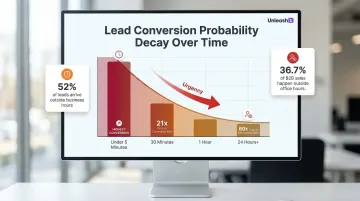
Sales teams lose deals every day not because their products fall short, but because leads vanish during the critical first five minutes after inquiry. A prospect lands on your website at 11 PM, fills out a form, and waits. By morning, they've already contacted three competitors. Research analyzing 1.25 million sales leads found that firms responding within an hour are nearly 7 times as likely to qualify the lead as those waiting 60 minutes and more than 60 times as likely as companies waiting 24 hours or longer. Buyer intent is perishable the window to convert is measured in minutes, not days.
This guide breaks down the specific, measurable ways AI chat assistants improve sales outcomes where the revenue gains actually come from, and how to put them to work.
Key Takeaways
- AI chat assistants engage prospects instantly, 24/7, capturing the 52% of leads that arrive outside business hours
- They personalize conversations using CRM and behavioral data delivering the 40% revenue lift linked to personalization
- They proactively recover abandoned carts and dormant leads, reclaiming revenue from the 70% of shoppers who abandon checkout
- Businesses without AI chat face higher cost-per-lead, inconsistent follow-up, and a ceiling on growth without adding headcount
- Value compounds when AI chat is integrated with sales workflows, synced to CRM, and reviewed for performance regularly
What Are AI Chat Assistants?
AI chat assistants are software-based agents that use natural language processing to hold real-time conversations with prospects and customers across chat, messaging apps, email, or voice without human involvement at every step.
In sales contexts, they handle a range of functions that would otherwise require dedicated human time:
- Qualifying inbound leads before they reach a rep
- Responding to inquiries across chat, email, and voice
- Delivering product recommendations based on buyer context
- Executing follow-up sequences automatically
- Recovering abandoned carts before they go cold
- Scheduling appointments without back-and-forth
UnleashX's Peter (Sales AI Employee), for instance, runs across calls, chat, and email around the clock nurturing leads and updating the CRM without any manual input.
The real value is eliminating friction points in the buyer's journey delayed responses, generic follow-ups, carts left without a recovery attempt. AI chat assistants convert those missed moments into closed deals.
Key Advantages of AI Chat Assistants for Sales
The three advantages below map directly to metrics sales leaders track: conversion rate, cost per lead, pipeline velocity, and deal closure rate. Each one targets a specific bottleneck where deals stall or disappear.
Always-On Lead Engagement
AI chat assistants respond to inbound inquiries in under a second, 24/7. No lead goes cold because the sales team was offline, in a meeting, or at capacity.
When a prospect lands on a website, clicks an ad, or sends a WhatsApp message at any hour, the AI engages immediately qualifies intent, answers product questions, and routes or books the lead. UnleashX's Peter operates across calls, chat, and email around the clock, engaging and nurturing leads autonomously while updating the CRM without manual input.
InsideSales research reviewing 55 million sales activities found that the odds of qualifying a lead drop 21 times when first contact happens after 30 minutes instead of 5. Yet 57.1% of first call attempts happen after more than a week and only 0.1% of inbound leads are engaged within 5 minutes.
Every hour a lead waits reduces the probability of conversion. The after-hours gap compounds this: HubSpot data shows 52% of leads come in outside standard business hours, while HeadQ reports 36.7% of all B2B sales transactions happen outside office hours. Relying solely on human reps means up to half your inbound pipeline waits days for a response instead of minutes.
KPIs impacted: lead response time, lead-to-opportunity conversion rate, after-hours inquiry capture rate, pipeline velocity
Maximum impact occurs for businesses with high inbound volume, pan-India audiences across time zones, or seasonal spikes situations where human capacity cannot keep pace without AI coverage.
Personalized Conversations at Scale
AI chat assistants connected to CRM systems and behavioral data tailor conversations to each prospect referencing their history, preferences, and stage in the buying journey making every interaction relevant rather than generic.
Rather than delivering a scripted FAQ response, a well-configured AI chat assistant identifies whether the visitor is a first-time prospect or a returning lead, adjusts its tone and product recommendations accordingly, and surfaces the most relevant offer. It does this simultaneously across thousands of conversations.
McKinsey research shows 71% of consumers expect personalized interactions, and 76% get frustrated when this doesn't happen. Companies that excel at personalization generate 40% more revenue from those activities than average players.
Generic outreach actively damages the pipeline. A 2025 Attentive survey of 3,300 consumers found that 81% ignore irrelevant messages, and 1 in 4 are less likely to purchase when receiving one.
When the AI pre-qualifies and personalizes before a human rep steps in, reps spend time only on high-intent, well-informed prospects improving close rates and productivity simultaneously.
KPIs impacted: conversion rate, average deal size, sales rep efficiency, customer lifetime value, upsell/cross-sell attach rate
Businesses with diverse product catalogs, long consideration cycles, or high volumes of repeat customers see the greatest impact blanket messaging consistently underperforms in these scenarios.
Proactive Cart and Lead Recovery
AI chat assistants don't just respond they initiate. They detect abandonment signals (cart exits, delayed form completions, dormant leads) and re-engage prospects with targeted messages through the right channel at the right time.
When a user abandons a cart or stops responding mid-conversation, the AI triggers a re-engagement sequence via WhatsApp, chat, or email guiding them back to checkout, addressing objections, and sending payment links without requiring manual follow-up.
The Baymard Institute's 2025 benchmark places the pan-India average cart abandonment rate at 70.22%, with $260 billion (approximately ₹2,158,000 crore) worth of lost orders recoverable through better intervention. UnleashX's Sarah re-engages dropped customers through voice, WhatsApp, and chat, guides them through checkout, and sends payment links autonomously until every lost cart turns into revenue.
Cart abandonment and lead drop-off are typically written off as lost revenue. AI chat changes that by acting before the prospect fully disengages and the economics strongly favor recovery over acquisition. Acquiring a new customer costs 5–25× more than re-engaging an existing one.
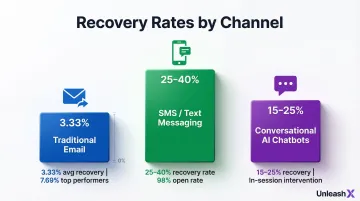
Recovery rates vary significantly by channel:
- Traditional email: 3.33% average, 7.69% for top performers
- SMS/text messaging: 25–40% with 98% open rates
- Conversational AI chatbots: 15–25%, intervening in-session before the user leaves
KPIs impacted: cart recovery rate, cost per acquisition, lead reactivation rate, revenue from existing pipeline
Highest impact for e-commerce businesses, SaaS free trial flows, and any business with a long sales cycle where leads tend to go cold between touchpoints.
What Happens When AI Chat Is Missing or Ignored
Without AI chat in place, sales operations tend to run on hope and memory. Leads that arrive outside business hours go unanswered. Follow-ups depend on individual reps remembering to act. The pipeline develops gaps that stay invisible until deals are already lost.
Where the Gaps Show Up
These aren't isolated problems. They compound:
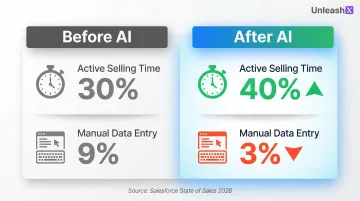
- Slow response times drive unpredictable conversion rates. Salesforce's 2024 State of Sales report found that sales reps spend just 30% of their time actually selling the rest goes to manual follow-up, data entry, and admin work.
- Capacity ceilings get hit fast. More leads mean more headcount, making growth expensive and slow. Sellers buried in administrative tasks are 45% less likely to hit quota.
- Reactive firefighting replaces proactive selling. Reps chase cold leads instead of closing warm ones, eroding both efficiency and morale.
The Scaling Problem
Businesses relying entirely on manual engagement watch their cost-per-lead rise as volume grows. AI-assisted businesses see the opposite: fixed infrastructure absorbs increasing demand without proportional cost increase.
How to Get the Most Value from AI Chat Assistants
AI chat assistants deliver compounding value when treated as an integrated part of the sales workflow, not a standalone widget. Platforms like UnleashX offer pre-built AI employees like Peter (Sales) and Sarah (Cart Recovery) deployable in under 45 minutes, with direct connections to CRMs, WhatsApp, email, and 200+ tools out of the box.
To get the most out of deployment, focus on two fundamentals:
- Full-funnel coverage: Apply AI chat at every stage first-touch lead engagement, mid-funnel nurturing, and post-purchase follow-up. Gaps in coverage mean lost revenue.
- Defined KPIs from day one: Set measurable targets before going live response rate, conversion rate, cart recovery rate, lead reactivation rate. Review monthly and use the data to refine conversation flows, triggers, and escalation logic.
Businesses that treat AI chat as a living system reviewing performance, adjusting logic, and refining workflows see results that compound quarter over quarter. That ongoing discipline is what separates modest gains from transformational ones.
The data backs this up. Salesforce's 2026 State of Sales report shows AI-enabled teams have increased active selling time from 30% to 40%, while manual data entry dropped from 9% to just 3%. That productivity shift is the direct result of AI chat implemented and optimized consistently not deployed and ignored.
Conclusion
The businesses seeing the largest revenue gains from AI chat aren't using it as a bolt-on feature. They've made it a core part of how their sales system operates ensuring no lead waits, every conversation stays relevant, and abandoned opportunities get recovered automatically.
Always-on engagement, contextual personalization, and proactive recovery compound over time. Each capability reinforces the others. The longer AI chat runs as part of your sales infrastructure, the more data it accumulates and the more precisely it can act on each interaction.
Every day without it is a day competitors are capturing leads you're losing to slow response times, generic outreach, and missed follow-up windows.
For Indian businesses operating across BFSI, IT services, real estate, insurance, and CRM integration workflows, the same pattern applies: multilingual coverage across English, Hindi, and regional languages, WhatsApp-first customer engagement, and compliance with RBI, IRDAI, and DPDP 2023 requirements together determine production-grade success.
Frequently Asked Questions
How are Indian SaaS firms and IT services integrating AI agents with CRMs?
Indian SaaS providers (Zoho, Freshworks) and IT services (TCS, Infosys, Wipro, HCLTech) integrate AI agents with HubSpot, Salesforce, Zoho, and Freshworks CRMs for sales, support, and renewal workflows. Native connectors plus WhatsApp Business API integration are standard, and deployments typically support English, Hindi, and regional languages for end-user-facing flows.
What Indian compliance considerations apply to CRM-AI integrations?
DPDP 2023 governs personal data handling, including cross-border data transfer for CRMs hosted outside India. RBI guidelines apply for BFSI clients. The IT Act governs data security and incident reporting. CRM-AI integrations targeting Indian customers must support data residency options, consent management, and audit logs sufficient for sectoral regulators.
How do Indian businesses prefer to handle AI-CRM rollouts?
Indian implementations typically start with a pilot in one business unit (often inside sales or customer support), expand to multilingual coverage including Hindi and one to two regional languages, and integrate WhatsApp Business as a primary channel before email. Phased rollouts with measurable KPIs are standard given Indian CIO preference for proof-of-value before scale-up.
What industries benefit most from AI chat assistants for sales?
E-commerce, insurance, banking, automotive, and SaaS see the highest impact all share high lead volumes, complex buying decisions, and demand for fast, personalized responses. Any business with significant after-hours inquiries or long sales cycles benefits substantially.
How long does it take to deploy an AI chat assistant for sales?
Modern AI employee platforms offer pre-built templates that go live in under an hour. More customized deployments with CRM integrations and multi-channel workflows typically take days, not months. UnleashX's pre-built AI employees including Peter (Sales) and Sarah (Cart Recovery) are live in 45 minutes with full CRM and multi-channel configuration included.
Can AI chat assistants handle complex sales conversations?
Advanced AI chat assistants built on large language models can handle back-and-forth conversations, objection handling, and context-aware recommendations. They work best when paired with clear escalation paths to human reps for high-stakes or sensitive discussions requiring judgment and relationship management.