
Introduction
Sales and marketing teams face a critical prioritization crisis: 63% of inbound B2B leads never receive a response, while sales reps spend 60% of their time on non-selling tasks. The result is a direct revenue leak. High-intent buyers wait hours or days for follow-up while reps chase unqualified prospects. By the time someone responds, competitors have already closed the deal.
That's the problem AI lead scoring solves. This guide is built for sales leaders, RevOps professionals, and marketing teams in high-volume industries like insurance, real estate, e-commerce, and SaaS where lead quality and response speed directly determine revenue. We'll define AI lead scoring, explain how it works end-to-end, outline measurable benefits, and walk through a practical implementation roadmap so you can deploy predictive scoring that actually converts.
Key Takeaways
- AI lead scoring uses machine learning to rank leads by conversion likelihood automatically
- Analyzes behavioral, demographic, firmographic, and engagement data in real time
- Delivers faster speed-to-lead, scalability, scoring consistency, and sales-marketing alignment
- Implementation involves connecting data sources, choosing a model, setting score thresholds, and automating follow-up
- Pairs best with automated outreach so scored leads receive immediate action rather than sitting in a queue
What Is AI Lead Scoring?
AI lead scoring uses machine learning algorithms to automatically evaluate and rank leads based on their predicted likelihood to become paying customers. Rather than treating all leads equally, AI scoring tells sales teams exactly who to call first, who to nurture, and who to deprioritize concentrating effort where it converts.
Traditional Lead Scoring vs. AI Lead Scoring
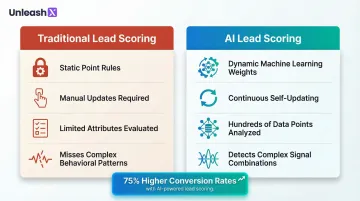
Traditional (rule-based) scoring assigns points manually to attributes like job title, company size, or form fills. A VP might get +10 points, a demo request +15, and so on. It's static, requires ongoing manual updates, and cannot detect complex behavioral patterns like "visits pricing page three times in 24 hours after downloading a whitepaper."
AI scoring continuously learns from historical conversion data, weights factors dynamically, and adapts to changing buyer behavior without manual rule updates. It identifies which combinations of signals most reliably predict a sale and keeps refining that model as new data comes in. Companies using AI-driven lead scoring report 75% higher conversion rates compared to traditional methods.
How AI Lead Scoring Works
AI lead scoring works in three stages: data collection, model training, and real-time scoring. Each stage feeds the next, and the system continuously sharpens itself as new conversion outcomes roll in.
Phase 1: Data Collection and Integration
The model ingests four types of data:
- Behavioral data - Website visits, email opens, content downloads, time on page
- Demographic data - Job title, seniority level, role
- Firmographic data - Industry, company size, revenue, location
- Engagement data - Webinar attendance, product demo requests, chat interactions
The model is only as good as the breadth and quality of data fed into it. Incomplete or siloed data produces unreliable scores.
Phase 2: Model Training and Pattern Recognition
The AI model trains on historical lead data, comparing attributes of leads that converted versus those that did not. The algorithm identifies which combinations of signals most reliably predict a sale and assigns weighted importance to each factor.
For example, it might discover that "CFO + fintech industry + visited pricing page twice + opened three emails" converts at 68%, while "Manager + healthcare + single website visit" converts at 9%. No manual scoring process catches signal combinations at that granularity which is what makes the pattern recognition phase the engine of the entire system.
Phase 3: Real-Time Scoring and Continuous Learning
Trained models score new leads automatically within seconds as they enter the pipeline, typically on a 0-100 scale. The model doesn't remain static. It retrains on new win/loss data over time, improving accuracy as more outcomes become available.
Two features define this phase:
- Continuous retraining : the model updates as deals close, keeping scores aligned with current buyer behavior
- Rapid refresh cycles : Salesforce Einstein reanalyzes lead data every 10 days to capture emerging trends
Key Benefits of AI Lead Scoring
AI lead scoring delivers measurable advantages over manual methods across speed, scale, consistency, and pipeline visibility. Here's what each benefit looks like in practice:
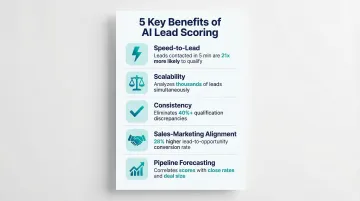
Speed-to-lead: AI scores leads within seconds of entry, so sales teams can reach the highest-intent prospects immediately. Leads contacted within 5 minutes are 21x more likely to qualify and convert at an 8x higher rate yet the average B2B response time is 47 hours.
Scalability: AI models process thousands of leads simultaneously without slowdowns. Traditional scoring evaluates 5-10 attributes; AI analyzes hundreds or thousands of data points at once critical for high-volume industries where inbound leads spike unpredictably.
Consistent, bias-free qualification: AI applies the same criteria to every lead, removing inconsistency caused by rep fatigue or subjective judgment. Manual scoring produces qualification discrepancies of 40% or more between team members. Note: bias can still appear through flawed training data or poorly constructed models.
Sales and marketing alignment: When both teams work from the same AI-generated score, MQL vs. SQL debates disappear. Misaligned teams cost B2B companies 10%+ of revenue annually, while aligned organizations see a 28% higher lead-to-opportunity conversion rate.
Pipeline forecasting: Lead scores correlate directly with close rates, deal size, and time-to-close giving revenue leaders a more precise basis for forecasting than flat conversion averages.
Pairing AI lead scoring with an autonomous sales AI like UnleashX's Peter closes the final gap: high-scored leads get immediate outreach via calls, chat, or email, 24/7, with no wait for a human rep.
How to Implement AI Lead Scoring
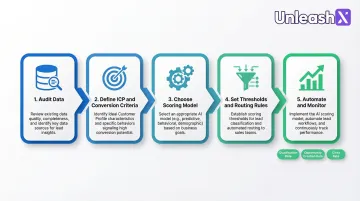
Step 1 – Audit and consolidate your data
Before selecting any tool, assess what data you already have in your CRM, marketing automation platform, and website analytics. Identify gaps missing firmographic data, incomplete behavioral tracking, siloed engagement metrics and address them through enrichment before training a model.
Up to 30% of B2B CRM records are outdated. Starting with clean, consolidated data prevents those errors from compounding once your model goes live.
Step 2 – Define your ideal customer profile and conversion criteria
Work cross-functionally with sales and marketing to agree on what a "converted lead" looks like closed deal, trial signup, demo booked and what attributes your best customers share. Without this alignment, the model trains on outcomes that may not reflect actual business goals.
Step 3 – Choose the right scoring model type
Four common approaches exist, and each serves a different prioritization goal:
- Purchase intent scoring - Prioritizes readiness to buy
- ICP scoring - Prioritizes fit with your ideal profile
- Engagement scoring - Prioritizes brand affinity
- Negative scoring - Filters out low-quality leads
Start with one model, then layer others as your program matures.
Step 4 – Set score thresholds and routing rules
Define what score range triggers immediate sales outreach (hot), what range enters a nurture sequence (warm), and what range gets deprioritized or flagged for review (cold).
Without clearly defined thresholds, lead scores remain data points rather than decision-making tools and that's where most implementations stall.
Step 5 – Automate follow-up and monitor model performance
Connect your scoring output to automated outreach workflows so high-scored leads receive immediate engagement without manual intervention. Then track performance by score band:
- Qualification rate - are scored leads actually sales-ready?
- Opportunity creation rate - are they converting to pipeline?
- Close rate - are they winning?
If any band underperforms, recalibrate your thresholds before the gap compounds.
Common Misconceptions About AI Lead Scoring
Misconception: A high lead score means a lead is ready to buy. A high score reflects resemblance to past converters, not confirmed purchase intent. Sales reps still need to qualify intent through conversation conflating score with certainty leads to wasted outreach.
Misconception: AI lead scoring works best with massive datasets. Many modern AI scoring tools are pre-trained on industry-wide data and can generate useful predictions even with a few hundred records. Salesforce Einstein requires at least 1,000 leads and 120 conversions within 200 days for custom models, but offers pan-India models trained on anonymized cross-tenant data as a fallback. Data quality and completeness matter more than raw volume.
When AI lead scoring may not be appropriate: AI scoring underperforms in several common scenarios:
- Short sales cycles with high transactional volume, where all leads are treated the same
- Businesses with fewer than a few dozen historical conversions to train on
- Organizations with poor CRM discipline inconsistent or incomplete data degrades model accuracy
In these cases, start with a structured manual scoring rubric instead.
Frequently Asked Questions
How are Indian B2B sales teams using AI agents for lead qualification?
Indian B2B SaaS, IT services, and BFSI sales teams run AI voice and chat agents to qualify inbound leads, run discovery calls in English and Hindi, and book demos. WhatsApp continuity, Hindi voice support, and CRM integration with HubSpot, Salesforce, and Zoho are standard. The pattern works especially well for Indian SMB outbound where Tier-2/3 buyers prefer voice and WhatsApp over email.
What is the difference between AI lead scoring and traditional lead scoring?
Traditional scoring uses static, manually assigned rules (for example, +10 for a job title match), while AI scoring dynamically learns patterns from actual conversion data and updates its weights continuously without manual intervention.
How do AI lead scoring models adapt to Indian buying behaviour?
Indian buyer journeys feature longer evaluation cycles, group decision-making across founders or CFOs, and a strong preference for WhatsApp and direct calls over forms. AI lead-scoring models trained on Indian patterns weight channel signals (WhatsApp engagement, voice call attendance), regional-language engagement, and decision-maker title differently than US-only models.
Which Indian companies are deploying AI for sales workflows in production?
Indian SaaS leaders (Zoho, Freshworks, Postman), IT services (TCS, Infosys, Wipro, HCLTech), and BFSI majors are running AI sales agents in production. Common deployments include AI-assisted SDR replies, voice-first lead revival on cold databases, multilingual qualification on WhatsApp, and pipeline scoring fed back into Indian CRMs.
Can small businesses benefit from AI lead scoring?
Yes, especially with tools pre-trained on third-party datasets. However, accuracy improves significantly once the business accumulates enough of its own win/loss data to fine-tune the model.
What should happen after a lead receives a high AI score?
A high score should trigger immediate, automated outreach, a personalized email sequence, a sales call, or a meeting booking request. Response speed is one of the strongest drivers of lead-to-opportunity conversion.