
Introduction
Sales teams are drowning in leads but most are unqualified. The pressure to respond faster while spending less has put AI voice agents and human SDRs in direct competition for the same job: separating real opportunities from dead ends before they consume sales bandwidth.
Speed, cost, and qualification accuracy each shape pipeline quality in different ways. Research shows that contacting a lead within 5 minutes makes qualification 21 times more likely than waiting 30 minutes yet the industry average response time sits at 42 to 47 hours.
When conversion probability decays that fast, choosing between AI and human qualification becomes a strategic decision that shapes revenue outcomes. This article breaks down how AI voice agents and SDRs compare across speed, cost, accuracy, and the scenarios where each performs best.
Key Takeaways
- AI voice agents qualify leads in seconds, 24/7, at 80-90% lower cost than human SDRs
- Human SDRs excel in complex, relationship-driven conversations where trust and nuance determine outcomes
- Speed, scale, and cost favor AI emotional intelligence and enterprise deal-closing favor humans
- Top-performing teams use AI for initial screening and humans for strategic follow-up
- Your choice depends on deal complexity, lead volume, and sales cycle length
AI Voice Agents vs Human SDRs: Quick Comparison
Response Speed
AI Voice Agents: UnleashX's Peter AI Employee engages leads in under 60 seconds around the clock, capturing the 391% conversion lift associated with immediate contact.
Human SDRs: Industry average response time is 42 to 47 hours according to Harvard Business Review and Drift/InsideSales research. Even well-staffed teams struggle to respond within the critical first hour when qualification odds are highest.
Cost
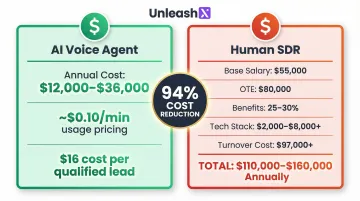
AI Voice Agents: Annual costs range from ₹10 lakh (≈ $12,000)to ₹29.9 lakh (≈ $36,000) with usage-based pricing averaging ~₹8 (≈ $0.10)per minute. One 2026 industry benchmark reported cost per qualified lead dropping from ₹24,100 (≈ $290)(human SDRs) to ₹1,300 (≈ $16)(AI SDRs), a 94% reduction.
Human SDRs: Fully-loaded annual cost reaches ₹91.3 lakh (≈ $110,000)to ₹1.3 crore (≈ $160,000) when factoring in:
- Base salary: ₹45.6 lakh (≈ $55,000)median
- OTE (On-Target Earnings): ₹66.4 lakh (≈ $80,000)- Benefits and payroll taxes: 25-30%
- Sales technology stack: ₹1.7 lakh (≈ $2,000)-₹6.6 lakh (≈ $8,000)+
- Management overhead
- Turnover cost: ₹80.5 lakh (≈ $97,000)+ per departure (50% annual turnover rate)
Scalability
AI Voice Agents: Handle thousands of simultaneous qualification calls without performance degradation. UnleashX's platform operates with <700ms latency and 99% uptime, enabling concurrent conversations across time zones without capacity constraints.
Human SDRs: Limited to 40 phone dials per day with an average of just 3.6 Quality Conversations daily (Bridge Group, 2023). Scaling requires linear headcount increases with 3.2-month ramp time per new hire.
Qualification Accuracy
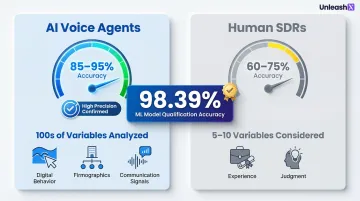
AI Voice Agents: Achieve 85-95% lead scoring accuracy by processing far more variables than any human can. For context, a 2025 study in Frontiers in Artificial Intelligence found that ML-based models (Gradient Boosting Classifiers) reached 98.39% accuracy in predicting B2B lead conversion signaling where AI-assisted qualification is headed.
Human SDRs: Typically achieve 60-75% accuracy by processing only 5-10 key variables. Qualification consistency varies based on experience, workload, and subjective judgment.
Availability
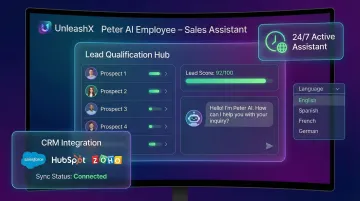
AI Voice Agents: Operate 24/7 with no downtime including after-hours and weekends when human teams are offline. UnleashX's Peter AI Employee handles calls, chat, and email in English and Hindi, ensuring no lead waits until the next business day.
Human SDRs: Constrained to business hours with availability dependent on staffing and geography. After-hours leads wait until the next business day, often missing the critical 5-minute response window.
What Are AI Voice Agents?
AI voice agents are autonomous systems that conduct real-time phone conversations with prospects using natural language processing. Unlike basic chatbots or IVR systems, they hold dynamic, two-way conversations, ask structured qualification questions (such as BANT- Budget, Authority, Need, Timeline), and route qualified leads automatically to human reps or CRM pipelines.
Unlike legacy systems, AI voice agents adapt based on prospect responses and take action autonomously like booking follow-up meetings, logging call notes, and triggering CRM updates. TechTarget defines them as "autonomous intelligent software components designed to perform specific tasks independently without human intervention, capable of exercising reasoning, making decisions, and taking actions." That combination of real-time adaptability and end-to-end execution is what separates them from scripted bots.
Operational advantages for sales teams include:
- 24/7 availability with no ramp-up time
- Deployable in minutes using pre-built templates (UnleashX's Peter AI Employee goes live in 45 minutes)
- Zero turnover cost with consistent qualification criteria applied to every call
- Multilingual capability for pan-India pipelines. Peter qualifies leads in English and Hindi, particularly relevant for markets like India where regional language support increases qualification rates
These advantages translate directly into how AI voice agents perform across different sales scenarios.
Use Cases of AI Voice Agents in Lead Qualification
High-volume inbound lead response: Instantly engages every form fill, demo request, or web inquiry within seconds preventing lead drop-off during the critical first-response window when conversion probability is 21x higher than waiting 30 minutes.
After-hours and weekend coverage: Captures and qualifies leads arriving outside business hours, ensuring no opportunity is missed due to staffing gaps. With 24/7 operation, AI agents eliminate the 42-hour average delay that kills most inbound leads.
Re-engagement of dormant or cold leads: Runs outbound qualification calls at scale to revive old leads in the CRM without consuming human SDR bandwidth. Property Point achieved **31% higher conversion from old leads** using voice SDR technology to systematically re-engage their database.
What Do Human SDRs Bring to Lead Qualification?
Human SDRs conduct discovery conversations that interpret tone and hesitation, ask adaptive follow-up questions, and apply contextual judgment beyond scripted qualification frameworks. They excel when a prospect's situation doesn't fit a standard profile reading between the lines to uncover hidden buying signals or deal-breaking objections.
Where human SDRs genuinely outperform AI:
- Complex B2B enterprise deals with multiple stakeholders requiring multi-threaded conversations
- High-ticket consultative sales where trust is built over multiple conversations, not single qualification calls
- Sensitive objections or competitive displacement scenarios requiring empathy, improvisation, and relationship capital
- Regulatory or compliance-heavy industries (financial services, healthcare) where human judgment mitigates risk
The cost and scalability reality, however, is difficult to ignore:
- A fully-loaded human SDR costs ₹91.3 lakh (≈ $110,000)–₹1.3 crore (≈ $160,000)annually
- Annual SDR turnover runs at 50%, with the average tenure just 1.4 years
- Each departure triggers ₹80.5 lakh (≈ $97,000)+ in replacement costs
- A 3.2-month ramp time means teams get roughly 13 months of peak output before restarting the cycle
Use Cases of Human SDRs
Enterprise and strategic accounts involve buying committees, multi-stage discovery, and relationship-building that carries into the sales cycle. These deals require consultative judgment that current AI systems rarely match.
High-stakes or sensitive industries like financial services, healthcare, legal carry regulatory context and emotional weight that make human judgment a practical necessity. Prospect discomfort or compliance risk can derail deals that a scripted system might mishandle.
Head-to-Head: Which Qualifies Leads Better?
Speed-to-Lead and First-Response Conversion
AI voice agents win decisively. Harvard Business Review research shows firms responding within one hour are 7 times more likely to qualify a lead than those waiting two hours, and 60 times more likely than those waiting 24 hours.
AI agents eliminate this decay curve entirely by responding in under a minute at any hour. Human SDRs, constrained by business hours and daily capacity limits, cannot physically sustain this response speed across all leads.
Qualification Consistency and Scoring Accuracy
AI applies the same BANT criteria (or custom qualification framework) to every call without variance. Human SDRs may skip steps when rushed, apply inconsistent criteria, or be influenced by a prospect's likability rather than objective fit.
Research confirms AI's edge: AI-powered systems achieve 85-95% accuracy versus 60-75% for human qualification. AI models analyze hundreds of variables simultaneously digital behavior, communication signals, firmographics while human reps typically consider only 5-10 key indicators.
Handling Objections and Complex Discovery
Human SDRs maintain the advantage here. AI voice agents work best when qualification criteria are structured and definable. When a prospect raises nuanced objections, negotiates scope, or needs education before being qualified, human judgment becomes essential.
Example: An enterprise prospect says "We're evaluating vendors but our CFO is concerned about integration complexity." A human SDR can probe the CFO's specific concerns, reference similar customer scenarios, and adjust the qualification conversation to address unspoken anxieties. AI agents handle this less effectively without predefined escalation logic.
For most teams, the strongest setup is a hybrid model: AI qualifies at volume and speed, human SDRs step in once a lead meets threshold criteria. This keeps acquisition costs low without sacrificing conversion quality on high-value deals.
Real-World Results: What Happens When Teams Deploy AI Voice Agents
Property Point, a real estate company managing hundreds of property leads across multiple price points, faced the classic high-volume qualification challenge: slow response times, unqualified meetings reaching closers, and rising SDR costs. Manual follow-up meant leads went cold before sales teams could engage, and the existing SDR team couldn't scale to match inbound volume.
After deploying UnleashX's Peter AI Employee for first-contact qualification, results showed up across every metric that mattered:
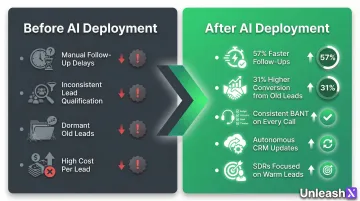
Before AI Deployment:
- Manual follow-up process with delays measured in hours or days
- Inconsistent qualification SDRs applied different criteria based on workload and experience
- Old leads in the database remained dormant, representing lost revenue
- High cost per lead due to SDR salary overhead and turnover
After AI Deployment:
- 57% faster customer follow-ups instant response to every inquiry
- 31% higher conversion from old leads systematic database re-engagement
- Structured qualification on every call using consistent BANT criteria
- Autonomous CRM updates eliminating manual data entry
- Human SDRs freed to focus entirely on warm, pre-qualified opportunities
CEO Ajit Kadian noted: "The voice SDRs revived our entire old database. People actually responded because the agent sounded natural, helpful and fully aware of our projects. Follow ups became instant. Interest checks became smoother. The sales team finally got real conversations instead of chasing dead ends."
AI voice agents improve pipeline quality, not just cost. When every lead gets a structured, immediate response, the qualification gap that capacity constraints create simply disappears. Property Point's sales team now spends 100% of their time on qualified conversations.
If your team faces the same challenge like slow follow-ups, inconsistent qualification, or SDR bandwidth stretched thin UnleashX's Peter AI Employee qualifies leads 24/7 and deploys in under 45 minutes.
Conclusion
For most businesses, AI voice agents win on speed, scale, consistency, and cost especially with high lead volumes, inbound-heavy pipelines, or distributed time-zone coverage. Human SDRs still own enterprise deals, complex discovery, and relationship-sensitive motions where judgment and empathy move the needle.
The strongest qualification strategy combines both. Use AI voice agents for first-contact qualification at scale; let human SDRs focus where relationship-building actually converts pipeline. That structure means more leads qualified, lower cost-per-opportunity, and SDR time spent where it counts.
Where each fits:
- AI voice agents: High-volume inbound, after-hours coverage, rapid disqualification, consistent BANT execution
- Human SDRs: Enterprise accounts, multi-stakeholder deals, nuanced discovery, relationship-driven sales cycles
78% of customers buy from the company that responds first. Speed is the first qualifier and AI voice agents are built to win it every time.
For Indian businesses operating across BFSI, IT services, real estate, insurance, and B2B sales workflows, the same pattern applies: multilingual coverage across English, Hindi, and regional languages, WhatsApp-first customer engagement, and compliance with RBI, IRDAI, and DPDP 2023 requirements together determine production-grade success.
Frequently Asked Questions
How are Indian B2B sales teams using AI agents for lead qualification?
Indian B2B SaaS, IT services, and BFSI sales teams run AI voice and chat agents to qualify inbound leads, run discovery calls in English and Hindi, and book demos. WhatsApp continuity, Hindi voice support, and CRM integration with HubSpot, Salesforce, and Zoho are standard. The pattern works especially well for Indian SMB outbound where Tier-2/3 buyers prefer voice and WhatsApp over email.
How do AI voice agents qualify leads differently from human SDRs?
AI voice agents apply consistent qualification criteria (such as BANT) to every call using natural language processing, evaluating hundreds of data points simultaneously. Human SDRs use adaptive questioning, emotional cues, and contextual judgment which makes AI the better fit for volume and consistency, and humans the better fit when complexity and nuance matter.
How do AI lead scoring models adapt to Indian buying behaviour?
Indian buyer journeys feature longer evaluation cycles, group decision-making across founders or CFOs, and a strong preference for WhatsApp and direct calls over forms. AI lead-scoring models trained on Indian patterns weight channel signals (WhatsApp engagement, voice call attendance), regional-language engagement, and decision-maker title differently than US-only models.
Which Indian companies are deploying AI for sales workflows in production?
Indian SaaS leaders (Zoho, Freshworks, Postman), IT services (TCS, Infosys, Wipro, HCLTech), and BFSI majors are running AI sales agents in production. Common deployments include AI-assisted SDR replies, voice-first lead revival on cold databases, multilingual qualification on WhatsApp, and pipeline scoring fed back into Indian CRMs.
How long does it take to deploy an AI voice agent for lead qualification?
Modern AI voice agent platforms deploy in as little as 45 minutes using pre-built templates compared to 3-6 months for a human SDR to ramp to full productivity. UnleashX's Peter AI Employee is production-ready in under 45 minutes with multilingual support across 100+ languages.
What happens when an AI voice agent encounters an objection or question it can't handle?
AI voice agents include escalation logic when a conversation exceeds predefined parameters, the call transfers to a human rep in real time. No lead is lost to AI limitations, and routine qualification stays fast.