
Voice AI APIs enable this shift by giving developers the building blocks to embed low-latency, human-like voice conversations directly into products and workflows. They eliminate the need to build complex telecom infrastructure or train speech models from scratch, reducing time-to-market from months to weeks.
Yet not all voice AI APIs are built for true real-time performance. Many platforms deliver impressive demos but falter under production call loads, struggle with latency above 1 second, or lack the telephony integration needed for actual phone calls. The conversational AI market is projected to reach $41.39 billion (approximately ₹343,500 crore) by 2030, growing at 23.7% annually, a clear signal that enterprise adoption is accelerating, but also that buyers must evaluate carefully.
This article evaluates the top voice AI APIs based on response latency, integration depth, conversational quality, and real-world deployment readiness. We focus on platforms proven in production environments, not just benchmark leaders.
Key Takeaways
- Voice AI APIs let developers add real-time speech understanding and response without building telecom or ML infrastructure independently
- Top platforms deliver sub-700ms latency, accurate transcription or synthesis, and full-duplex dialogue not just one-way playback
- Key selection factors: response latency, language support, telephony compatibility, LLM integration, and pricing transparency
- Top options: OpenAI Realtime API, Deepgram, ElevenLabs Conversational AI, Vapi, and Twilio Programmable Voice
- Teams skipping API assembly can use UnleashX to deploy pre-built AI agents across voice and chat in under 45 minutes
What Are Voice AI APIs and Why Do They Matter for Real-Time Conversations?
Voice AI APIs are developer interfaces that expose capabilities like real-time speech-to-text (STT), text-to-speech (TTS), or end-to-end speech-to-speech (STS). They let applications listen, interpret, and respond in natural language without building ML models or telecom infrastructure from scratch.
Real-time conversational use cases like sales calls, customer support, IVR replacement, HR screening demand more than simple transcription. Specifically, they require:
- Full-duplex audio streaming
- Turn detection and voice activity detection (VAD)
- Sub-700ms end-to-end latency
- Context-aware responses
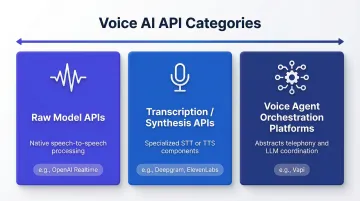
Voice AI APIs generally fall into three categories:
- Raw model APIs (like OpenAI Realtime) handle native speech-to-speech processing end-to-end
- Transcription/synthesis APIs (like Deepgram and ElevenLabs) deliver specialized STT or TTS components
- Voice agent orchestration platforms (like Vapi) abstract telephony and LLM coordination into a single API
The section below evaluates five leading platforms across these dimensions, prioritizing real-world suitability over benchmark scores alone.
Top Voice AI APIs for Real-Time Conversational Integration
These APIs were evaluated on response latency, conversational quality, integration flexibility, language coverage, telephony readiness, and developer experience. Only platforms proven in production environments made the cut, demo-only tools were excluded.
OpenAI Realtime API
OpenAI's Realtime API is a native speech-to-speech model interface enabling low-latency, bidirectional audio streaming directly between users and GPT-based models. It removes the traditional STT → LLM → TTS pipeline, handling audio natively through WebRTC and WebSocket transport.
Why it stands out:
The API supports voice activity detection, real-time transcription, tool calling, and turn-based dialogue in a single model call making it one of the most complete options for building voice agents without coordinating multiple vendors. The platform supports 98+ languages including Afrikaans, Arabic, English, Hindi, Tamil, and Welsh.
| Feature | Details |
|---|---|
| Key Features | Native S2S audio, VAD, tool calling, real-time transcription, WebRTC/WebSocket/SIP support |
| Performance | Low-latency communication (specific end-to-end millisecond guarantees not published) |
| Pricing | gpt-realtime-1.5: ₹2,700 (≈ $32)/1M audio input tokens, ₹5,300 (≈ $64)/1M output tokens; gpt-realtime-mini: ₹830 (≈ $10)/1M audio input, ₹1,700 (≈ $20)/1M output |
OpenAI does not publish explicit sub-700ms latency guarantees, but the architecture's native speech processing eliminates multi-vendor coordination delays.
Deepgram
Deepgram specializes in AI-powered real-time speech recognition, offering one of the fastest and most accurate transcription APIs available. It's widely used as the STT backbone in voice AI stacks across customer support, sales automation, and compliance workflows.
Why it stands out:
Deepgram's Nova-3 model delivers sub-300ms streaming latency with support for 45+ languages and custom vocabulary training. In internal benchmarks across 81 hours of audio, Nova-3 achieved a median Word Error Rate (WER) of 6.84% for streaming and 5.26% for batch processing. It also offers a TTS API (Aura), though it functions best as part of a broader voice pipeline rather than a standalone conversational solution.
| Feature | Details |
|---|---|
| Key Features | Real-time STT, TTS, speaker diarization, custom vocabulary, 45+ languages, multilingual code-switching |
| Performance | Sub-300ms streaming latency, 6.84% median WER for streaming |
| Pricing | Nova-3 streaming: ₹0.64 (≈ $0.0077)/min (Pay-As-You-Go), ₹0.54 (≈ $0.0065)/min (Growth); Aura TTS: ₹2 (≈ $0.030)per 1,000 characters |
Deepgram's hard latency guarantees make it a reliable foundation for call-center-grade transcription.
ElevenLabs Conversational AI API
ElevenLabs is best known for hyper-realistic voice synthesis and cloning but has expanded into a Conversational AI API supporting low-latency, agent-driven voice dialogues. It enables developers to build voice agents with highly expressive, human-like TTS at their core.
Why it stands out:
ElevenLabs differentiates on voice quality and naturalness offering voice cloning, multilingual support, and agent configuration via API. Its Flash v2.5 model generates speech in under 75ms, and the Eleven v3 model supports 74 languages. However, it requires pairing with telephony infrastructure for phone-based use cases, making it strongest for web and app-embedded conversational experiences.
| Feature | Details |
|---|---|
| Key Features | Voice cloning, multilingual TTS (74 languages), Conversational AI API, agent configuration, emotion control |
| Performance | Flash v2.5: <75ms TTS latency; end-to-end conversational latency not published |
| Pricing | Starter: ₹415 (≈ $5)/mo (30k credits); Creator: ₹1,800 (≈ $22)/mo (100k credits); Pro: ₹8,200 (≈ $99)/mo (500k credits); Business: ₹1.1 lakh (≈ $1,320)/mo (11M credits, ~5¢/min) |
ElevenLabs excels in voice quality but requires third-party SIP/telephony integration (like Twilio or Vonage) to handle phone calls.
Vapi
Vapi is a developer-first voice agent API platform designed specifically for building AI-powered phone agents. It abstracts telephony infrastructure and LLM orchestration into a single API, enabling developers to go from code to live voice agent quickly.
Why it stands out:
Vapi supports integration with multiple LLMs (OpenAI, Anthropic, Google Gemini, Groq), STT providers (Deepgram, Gladia, AssemblyAI, Speechmatics), and TTS engines (ElevenLabs, PlayHT, Cartesia, Deepgram). It explicitly targets end-to-end conversational latency of p50 <500ms and p95 <800ms.
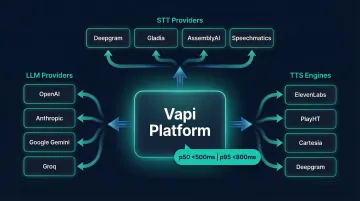
It handles call management, real-time audio streaming, and function calling out of the box. Note that it's optimized for prototyping and mid-scale deployments and may require additional configuration for complex enterprise routing.
| Feature | Details |
|---|---|
| Key Features | Multi-LLM support, custom STT/TTS selection, inbound/outbound calls, function calling, webhooks, 10 concurrent call slots default |
| Performance | Target latency: p50 <500ms, p95 <800ms |
| Pricing | ₹4 (≈ $0.05)/min platform fee + at-cost provider charges (STT, LLM, TTS, telephony); additional concurrency: ₹830 (≈ $10)/line/month |
Vapi requires "Bring Your Own API Key" for telephony layers like Twilio, Telnyx, or Plivo.
Twilio Programmable Voice + Media Streams
Twilio is one of the most established pan-India telephony API providers, offering Programmable Voice and Media Streams, a feature that exposes raw call audio over WebSockets for real-time AI processing. Developers can plug in transcription, LLMs, and TTS to build conversational agents on top of carrier-grade infrastructure.
Why it stands out:
Twilio's key strength is pan-India PSTN access, scale, and ecosystem depth: it integrates with virtually every CRM, contact center tool, and AI platform. The platform provides voice termination to nearly 200 locales across India and offers phone numbers in over 100 countries.
Building a full real-time conversational agent on Twilio, however, requires assembling STT, LLM, and TTS layers separately making it better suited for teams with engineering resources than those seeking rapid deployment.
| Feature | Details |
|---|---|
| Key Features | PSTN calling, SIP trunking, Media Streams (WebSocket audio), inbound/outbound IVR, pan-India numbers, 99.95% API uptime SLA |
| Performance | No published end-to-end latency for raw Media Streams; ConversationRelay product: <0.5s median, <0.725s at p95 |
| Pricing | US local voice: ₹0.71 (≈ $0.0085)/min inbound, ₹1 (≈ $0.0140)/min outbound; Media Streams: +₹0.33 (≈ $0.0040)/min |
It's the right choice when pan-India reach and carrier-grade reliability matter more than out-of-the-box conversational assembly.
How We Chose the Best Voice AI APIs
Shortlisted APIs were assessed against the practical demands of real-time conversational integration. A common mistake buyers make is selecting based on demo quality or brand recognition alone, without testing latency under real call conditions or verifying support for their specific use case (inbound support, outbound sales, multilingual IVR).
Core evaluation factors included:
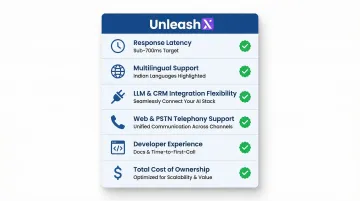
- Targets sub-700ms end-to-end response latency human conversational turn-taking averages 200-300ms, and delays above 1 second disrupt conversational flow
- Supports multilingual markets, with particular weight given to Indian languages (Hindi, Tamil, Bengali)
- Integrates flexibly with LLMs, CRM systems, and business tools
- Handles both web and PSTN telephony not just browser-based calls
- Offers strong developer experience: clear documentation, fast time-to-first-call, and responsive support
- Carries a realistic total cost of ownership when STT, LLM, TTS, and telephony are assembled together
For teams in insurance, banking, or e-commerce, passing an API evaluation is necessary but not sufficient. Compliance logging, CRM sync, and workflow orchestration often require a separate integration layer that raw APIs don't provide out of the box. UnleashX addresses this directly: its pre-built AI employees for sales, support, and HR deploy in under 45 minutes, with IRDAI/GDPR compliance and CRM integration already configured.
Conclusion
The right voice AI API depends on what layer of the stack you're building at. OpenAI Realtime suits teams who want native S2S. Deepgram and ElevenLabs serve as best-in-class components. Vapi abstracts orchestration. Twilio provides the telephony backbone. Most production systems will combine two or more.
Before committing to a stack, work through three decisions:
- Latency under real conditions : benchmark in live call environments, not sandboxes
- Multilingual scope : define language requirements before architecture, not after
- True infrastructure cost : account for the engineering overhead of maintaining multiple API integrations
If that effort outweighs the benefit, a pre-built solution may serve your business goals faster.
For teams that want to skip the API assembly entirely, UnleashX deploys full-stack AI employees across voice, chat, and email. Purpose-built for sales, support, and hiring workflows, it goes live in under 45 minutes with 98% accuracy and sub-700ms latency.
Frequently Asked Questions
What is the difference between a voice AI API and a voice agent platform?
A voice AI API offers raw building blocks (STT, TTS, or S2S) that developers integrate into their own stack. A voice agent platform combines those components with orchestration, call management, and conversation logic into a deployable product reducing time-to-market but offering less customization.
How do AI voice agents handle Hindi and regional languages for Indian customers?
Modern voice AI platforms support natural conversations in Hindi, Tamil, Telugu, Kannada, Marathi, Bengali, and code-mixed Hinglish. UnleashX voice agents detect caller language automatically, switch mid-call where needed, and integrate with WhatsApp for follow-ups, which matches how Indian buyers in BFSI, real estate, and D2C actually engage.
Can voice AI APIs support multiple languages, including regional or Indian languages?
Support varies widely by provider. Deepgram and ElevenLabs support 30-74 languages, while OpenAI Realtime matches Whisper's 98+ language support. Specialized platforms may cover regional languages like Tamil, Hindi, or Bengali teams serving multilingual markets should confirm exact language coverage with each provider.
Which Indian companies are deploying AI voice agents in production?
Indian BFSI majors (HDFC, ICICI, SBI, Axis), real estate firms, lending NBFCs, and D2C brands are running voice AI in production for sales calls, KYC follow-ups, and customer support. NASSCOM has tracked rapid adoption across IT services and BPO firms (TCS, Infosys, Wipro, HCLTech) building voice AI practices for Indian and pan-India enterprise clients.
What are the main use cases for real-time voice AI API integration?
Key use cases include AI sales agents for inbound/outbound calling, automated customer support IVR, HR candidate screening, real-time call analytics, cart recovery or lead nurturing through voice, and policy renewal automation in insurance and financial services.
What Indian regulations should I consider before deploying voice AI?
DPDP 2023 governs personal data handling in voice interactions, including consent capture and audit trails. RBI guidelines on outsourcing apply to BFSI deployments, IRDAI rules cover insurance workflows, and TRAI's commercial communication rules govern outbound calling. Production-grade voice AI platforms maintain call recordings, language logs, and consent receipts to meet these requirements.