
Introduction
Modern logistics operations coordinate thousands of dock appointments, carrier pickups, and delivery windows daily. That scheduling burden has a direct cost. According to the industry research, drivers experienced detention at 39.3% of all stops in 2023, costing the trucking industry $15.1 billion (approximately ₹125,300 crore) in lost productivity and direct expenses.
Logistics planners spend roughly 6.5 hours every workday on exception management, chasing emails, making check-calls, and updating systems. That represents a labor drain of ₹64.7 lakh (≈ $78,000)to ₹1.3 crore (≈ $156,000)annually per planner.
Voice AI agents are replacing manual phone-based scheduling in logistics, enabling 24/7 appointment booking, real-time availability checks, and seamless TMS/WMS updates without human intervention. These autonomous systems handle inbound carrier calls, proactively confirm pickup windows, and instantly reschedule missed slots, cutting the communication delays that keep trucks waiting beyond their scheduled windows.
This guide breaks down the best voice AI agents built for logistics appointment scheduling, what to look for when evaluating them, and how to match the right solution to your operation's scale and workflow.
Key Takeaways
- Voice AI agents automate high-volume dock appointments, carrier pickups, and delivery windows 24/7
- Top platforms combine low-latency conversations, TMS/WMS integration, and autonomous CRM updates
- Shortlist platforms on latency (under 800ms), uptime (99%+), integration depth, and logistics workflow fit
- Leading options: Retell AI, Bland AI, Vapi, Synthflow, and UnleashX
- Match your pick to call volume, technical capacity, and whether you need plug-and-play or a custom build
What Is Voice AI Scheduling and Why Does Logistics Need It Now
Voice AI agents for appointment scheduling are software systems that conduct real phone conversations using Natural Language Processing (NLP) to understand scheduling intent, check availability in real time, and confirm or modify appointments autonomously. Unlike legacy IVR menu systems that force callers through rigid "Press 1 for scheduling" prompts, modern voice AI handles multi-turn, contextual conversations that feel natural and resolve scheduling requests in a single call.
The logistics scheduling burden is particularly acute. Daily scheduling calls pile up across every layer of the operation:
- Freight carriers calling in for dock window confirmations
- Dispatchers making outbound calls to drivers for pickup reminders
- Warehouse teams coordinating capacity across multiple facilities
- Last-mile operations assigning and adjusting delivery slots
These repetitive calls tie up dispatch staff for hours each day, pulling focus away from exception handling and strategic coordination.
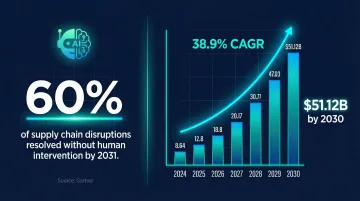
That volume is exactly why the industry is moving fast on automation. Gartner projects that by 2031, 60% of supply chain disruptions will be resolved without human intervention. The AI in supply chain market is expanding at a$51.12 billion (approximately ₹424,300 crore)xpected to reach ₹424,296 crore (≈ $51.12 billion) by 2030.
Best Voice AI Agents for Logistics Appointment Scheduling
These platforms were evaluated based on their ability to handle real logistics call scenarios not just generic scheduling including TMS integration, multi-carrier coordination, and 24/7 operational reliability.
Retell AI
Retell AI is an enterprise-grade voice AI platform with dedicated logistics use cases, built to handle inbound/outbound scheduling calls for dispatch, freight, and carrier coordination at scale. Key capabilities include:
- SOC 2 Type II compliance for enterprise security requirements
- High-availability infrastructure that prevents dropped calls during peak freight periods
- Call transfer and post-call analysis for dispatch quality assurance
- White-label capability for logistics operators maintaining brand consistency
The batch outbound calling feature (with a small per-dial surcharge) suits proactive carrier reminder campaigns and driver confirmation workflows that run automatically across hundreds of contacts.
| Feature | Details |
|---|---|
| Key Features | SOC 2 compliance, call transfer, post-call analysis, logistics-specific deployment templates, batch outbound calling |
| Pricing | ₹6 (≈ $0.07)- ₹26 (≈ $0.31)/min pay-as-you-go; ₹664 (≈ $8)/mo per concurrency after 20 free lines |
| Best For | Mid-to-large logistics operators, 3PLs, and freight brokers needing enterprise-grade reliability and compliance |
Bland AI
Bland AI is a developer-first voice AI infrastructure platform well-suited for logistics companies that need to build custom scheduling workflows such as multi-stop freight coordination, carrier-specific booking logic, or integration with proprietary TMS platforms. The platform provides full API control over conversation design, enabling technical teams to craft precise dialogue flows that match their unique operational requirements.
Its webhook-based architecture handles TMS/WMS updates in real time: when appointments are booked or modified during a live call, the platform triggers immediate data syncs to external systems.
This matters for logistics operations where dispatch, warehouse, and carrier-facing teams all need instant visibility into scheduling changes.
| Feature | Details |
|---|---|
| Key Features | API-first architecture, custom conversation flows, outbound calling, webhook integration, call recording and transcription |
| Pricing | Plan-based: ₹12 (≈ $0.14)/min (Free), ₹10 (≈ $0.12)/min (₹24,800 (≈ $299)/mo), ₹9 (≈ $0.11)/min (₹41,400 (≈ $499)/mo); ₹1 (≈ $0.015)outbound minimum |
| Best For | Logistics companies with in-house dev teams building bespoke carrier scheduling or dispatch automation workflows |
Vapi
Vapi is a low-latency voice AI platform that prioritizes natural, real-time conversation flow critical in logistics where drivers and dispatchers expect immediate, accurate responses on appointment availability. The platform's sub-second response latency prevents unnatural pauses during high-pressure dispatch calls, maintaining the conversational pace that time-pressed callers require.
Key differentiators include real-time function calling to check dock availability or TMS slot status during live conversations, interruption handling for quick back-and-forth exchanges typical in freight coordination, and live call monitoring for quality assurance. The platform's ~800ms typical end-to-end latency ensures conversations feel responsive and professional.
| Feature | Details |
|---|---|
| Key Features | Ultra-low latency (~800ms), real-time function calling, interruption handling, live call monitoring, multi-language support |
| Pricing | ₹4 (≈ $0.05)/min platform hosting + LLM/TTS/STT costs; ₹830 (≈ $10)/mo per concurrency after 10 free lines |
| Best For | Logistics teams prioritizing conversation naturalness and real-time TMS slot-checking during live calls; developer-led teams |
Synthflow
Synthflow is a no-code voice AI platform that allows logistics operators including regional carriers, freight brokers, and smaller 3PLs to deploy scheduling voice agents through a visual drag-and-drop builder without requiring engineering resources.
Operations teams can launch scheduling automation without waiting on developer availability, making it one of the faster paths to production for non-technical teams.
The platform includes:
- Pre-built scheduling templates adaptable to dock booking or carrier window confirmation
- Native integrations with Salesforce, HubSpot, Google Calendar, and Cal.com
- Automated SMS confirmations post-booking to reduce no-shows
The fixed monthly pricing model suits teams with predictable call volumes who want cost certainty.
| Feature | Details |
|---|---|
| Key Features | Visual no-code builder, pre-built scheduling templates, SMS confirmations, calendar/CRM integration, call analytics |
| Pricing | ₹7 (≈ $0.09)/min Voice Engine pay-as-you-go; ₹1,700 (≈ $20)/mo per extra concurrency after 5 free; ₹1.7 lakh (≈ $2,000)/mo white-label |
| Best For | Small-to-mid-sized logistics operators, regional carriers, or freight brokers without dedicated dev teams |
UnleashX
UnleashX is a full-stack AI employee platform that handles end-to-end logistics appointment scheduling across voice, chat, and email updating CRMs and syncing with external systems, all deployable in under 45 minutes. Where single-channel voice platforms stop at the call, UnleashX orchestrates the full workflow: answering inbound carrier calls, sending SMS confirmations, updating scheduling systems, and proactively reaching out via email when appointments need rescheduling.
For logistics specifically, the platform delivers:
- <700ms latency for natural dispatch-style conversations
- 24/7 availability for cross-timezone freight coordination
- 98% accuracy in call handling with 99% uptime
- Autonomous sync across 200+ tools, including CRMs and business management platforms
- 100+ language support for pan-India freight operations
- Human-in-Loop oversight for edge cases requiring manual intervention
The 45-minute deployment time means logistics teams can go live the same day.
| Feature | Details |
|---|---|
| Key Features | Full-stack AI employee (voice + chat + email), <700ms latency, 98% accuracy, 200+ tool integrations, 100+ language support, Human-in-Loop, 45-min deployment |
| Pricing | Contact UnleashX directly via website or WhatsApp (+919911997433) for pricing tailored to call volume and workflow complexity |
| Best For | Logistics companies of any size seeking a production-ready, autonomous scheduling AI that operates 24/7 without stitching together multiple tools |
How We Chose the Best Voice AI Agents for Logistics
A common mistake buyers make is selecting tools built for healthcare or retail, then assuming they'll handle freight coordination, multi-carrier logic, and TMS integration without customization. They won't.
Logistics scheduling requires more than basic appointment booking, it means handling detention windows, coordinating multi-stop pickups, managing carrier-specific requirements, and syncing data across warehouse and dispatch systems simultaneously.
Key evaluation factors tied to logistics business outcomes:
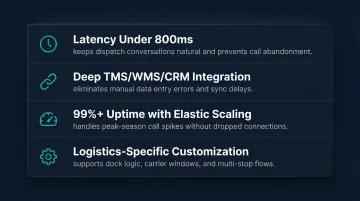
- Latency under 800ms : Slow responses frustrate time-pressed drivers and dispatchers, leading to call abandonment. Sub-800ms latency keeps conversations natural and on track.
- Deep TMS/WMS/CRM integration : Scheduling data must flow automatically across systems. The industry benchmark for manual data entry errors sits at 1%, and manual processes cost U.S. companies ₹23.7 lakh (≈ $28,500)per employee annually. Real-time API and webhook integration cuts both risks.
- 99%+ uptime with elastic scaling : Logistics runs around the clock and surges during peak seasons. Platforms must handle concurrent call spikes without dropped connections.
- Logistics-specific customization : Dock scheduling logic, carrier-specific windows, and multi-stop coordination go beyond generic templates. Look for platforms supporting conditional logic and custom conversation flows.
Beyond these core criteria, compliance and security carried significant weight. Logistics operators handle sensitive shipment and carrier data, so platforms needed demonstrable certifications (SOC 2 Type II, GDPR, ISO 27001), clear audit trails, and transparent pricing not just feature lists.
Conclusion
Choosing the right voice AI agent for logistics appointment scheduling comes down to three things: integration with your operational stack, ability to scale with call volume, and the scheduling logic to handle freight and warehouse coordination. Research shows that AI-driven scheduling platforms achieve appointment confirmation rates exceeding 95% and reduce exception rates to below 5%, directly reducing detention costs that cut into logistics margins.
Match the platform to your workflow:
- Dev-heavy teams : Bland AI or Vapi offer deep customization and API flexibility
- Lean ops teams : Synthflow's no-code approach reduces implementation overhead
- Enterprise teams : Retell AI provides the compliance infrastructure regulated industries require
- Teams needing fast deployment : UnleashX goes live in under 45 minutes with full-stack AI employees and no external tool dependencies
For Indian businesses operating across BFSI, IT services, real estate, insurance, and Voice AI workflows, the same pattern applies: multilingual coverage across English, Hindi, and regional languages, WhatsApp-first customer engagement, and compliance with RBI, IRDAI, and DPDP 2023 requirements together determine production-grade success.
Frequently Asked Questions
How do AI voice agents handle Hindi and regional languages for Indian customers?
Modern voice AI platforms support natural conversations in Hindi, Tamil, Telugu, Kannada, Marathi, Bengali, and code-mixed Hinglish. UnleashX voice agents detect caller language automatically, switch mid-call where needed, and integrate with WhatsApp for follow-ups, which matches how Indian buyers in BFSI, real estate, and D2C actually engage.
Which Indian companies are deploying AI voice agents in production?
Indian BFSI majors (HDFC, ICICI, SBI, Axis), real estate firms, lending NBFCs, and D2C brands are running voice AI in production for sales calls, KYC follow-ups, and customer support. NASSCOM has tracked rapid adoption across IT services and BPO firms (TCS, Infosys, Wipro, HCLTech) building voice AI practices for Indian and pan-India enterprise clients.
What Indian regulations should I consider before deploying voice AI?
DPDP 2023 governs personal data handling in voice interactions, including consent capture and audit trails. RBI guidelines on outsourcing apply to BFSI deployments, IRDAI rules cover insurance workflows, and TRAI's commercial communication rules govern outbound calling. Production-grade voice AI platforms maintain call recordings, language logs, and consent receipts to meet these requirements.
Can AI voice agents integrate with TMS or WMS platforms?
Most enterprise-grade voice AI platforms support TMS/WMS integration via APIs, webhooks, or pre-built connectors. Integration depth varies by platform. Logistics teams should confirm real-time data sync capability not just post-call export before deploying to avoid manual re-entry errors downstream.
How do voice AI agents help reduce detention time in logistics?
Industry data shows that AI scheduling platforms increase on-time performance by 25% and reduce exception rates to below 5%. They achieve this by automating appointment confirmations, proactively confirming carrier arrival windows, and instantly rescheduling missed slots eliminating the communication delays that drive detention costs.
How quickly can a logistics team deploy a voice AI scheduling agent?
Pre-built platforms like UnleashX can go live in as little as 45 minutes, while fully custom API solutions like Bland AI or Vapi take several weeks depending on integration complexity. Comprehensive TMS/WMS integrations typically follow a 3-6 month roadmap.