
VOICE CAPABILITY
Understanding the caller
Caller
“Could you book a consultation for Tuesday morning?”
AI employee
“I can help arrange that. Which time zone should I use?”
VOICE AGENTS · A WORKFORCE CAPABILITY
Voice is a channel, not the product. The same job runs on WhatsApp, chat and email, and it is judged on the record it leaves behind.
FROM SPOKEN INTENT TO VERIFIED WORK
Explore a booking, a caller correction and a commercial exception. See what the caller hears and the system actions the employee takes.
 Voice, connected to workWorked example
“Could you book a consultation for Tuesday morning?”
“I can help arrange that. Which time zone should I use?”
Capture the requested day; clarify the time zone.
Intent captured · no appointment created
AI employee
Routine scheduling proceeds within configured calendar permissions.
INSIDE THE BUILDER
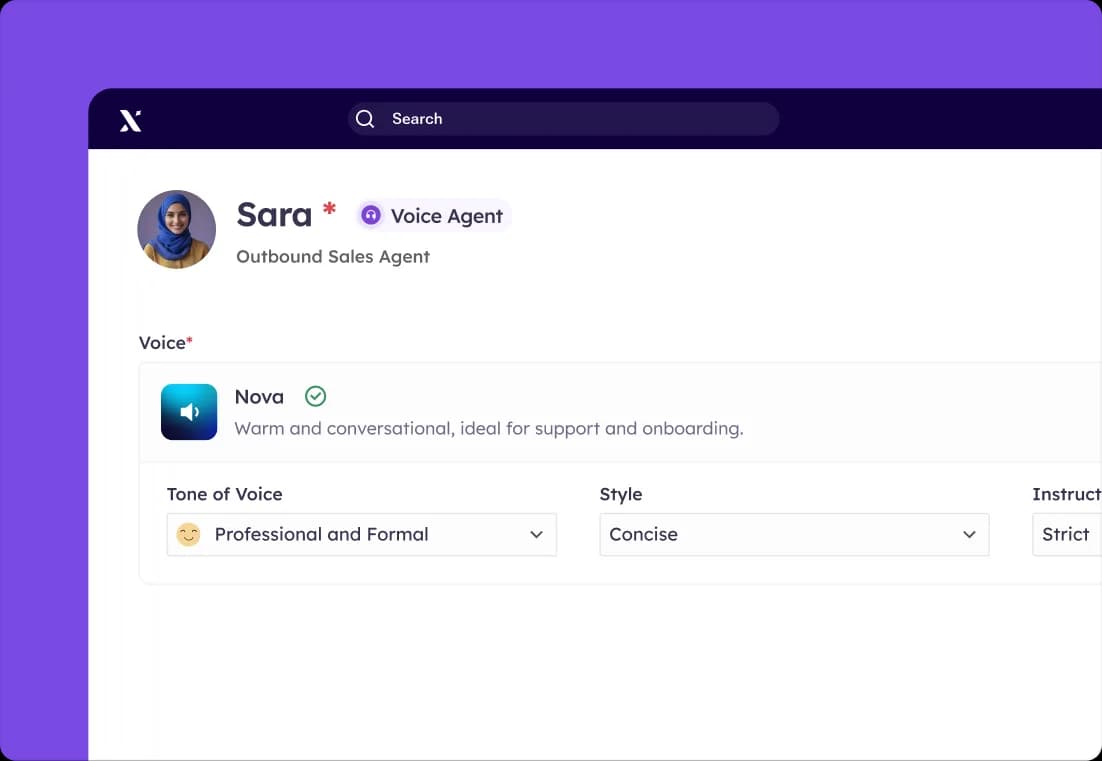
Define the instructions, shape the conversation and connect the actions behind it. Explore voice settings, role guidance and handoff configuration.
The voice, tone and response-style controls sit together, so the conversation can be configured around the role.
DESIGN AROUND THE RESPONSIBILITY
Choose the business outcome first, then scope the conversation, system access and exception rules. Confirm channel and integration availability for your deployment.
Understand the caller’s intent, answer from approved knowledge and capture the details needed for the next action.
Boundary: clarify identity before exposing customer-specific information.
Follow up on an enquiry or pending step using the agreed contact permissions, timing rules and stop conditions.
Boundary: do not treat an unanswered call as a completed follow-up.
Check available slots, confirm the caller’s choice and verify the booking before communicating the result.
Boundary: corrections after a write require verified rescheduling.
Capture the issue, retrieve permitted context and complete an in-scope service step or prepare a useful handoff.
Boundary: live transfer and callback are distinct outcomes.
Capture structured details and write agreed fields to the correct business record when authorized.
Boundary: spoken ambiguity must not become an arbitrary record change.
Recognize a request that exceeds authority and route it with the decision needed and completed work.
Boundary: a handoff is not approval and a promise is not a system result.
MORE THAN A TRANSCRIPT
Connect the voice experience to the same permissions, orchestration and evidence used by the rest of your workforce. Keep attempted, confirmed and unresolved actions distinct.
| During the conversation | Behind the conversation | Evidence to retain |
|---|---|---|
| Understand the request | Identify intent and clarify missing or uncertain fields. | Structured intent and unresolved questions. |
| Use relevant context | Retrieve permitted records and approved guidance. | Source references and identity checks required by the workflow. |
| Agree the next action | Confirm key details and check role authority. | Agreed parameters and the applicable action boundary. |
| Perform the task | Call a supported system operation and inspect its result. | Destination reference and confirmed or unresolved state. |
| Hand off an exception | Send the reason, context and decision request to the named owner. | Owner, handoff status and resumption condition. |
TEST THE REAL CALL CONDITIONS
Assess the proposed voice setup with representative callers and difficult scenarios. Define expectations before launch instead of relying on a universal latency or accuracy claim.
Test accents, domain vocabulary, background noise, silence and corrections. Define when uncertain names, dates or amounts must be repeated or clarified.
Confirm numbers, supported regions, call direction and routing. Test dropped calls, unavailable reviewers and the distinction between transfer, callback and case creation.
Agree contact permissions, disclosure, recording and transcription settings. Review the data passed to channel providers, connected tools and retained records.
Inspect final records, premature confirmations and duplicate actions. Define what the caller hears if a tool times out and who owns the unresolved work afterward.
HIRE OR BUILD
Start with a pre-built employee or design a role around your process. Scope voice access alongside knowledge, system actions and the responsibility the employee will own.
Explore roles with a defined job and discuss the voice workflow, integrations and authority required for your team.
Explore AI employees →Define a custom responsibility, then connect voice with the tools and handoffs needed to complete the work.
Build your workforce →VOICE AGENT QUESTIONS
No. Voice is a channel an AI employee works through, not the product. The same job runs on WhatsApp, chat and email, and it is judged on the completed work and the record it leaves behind.
An AI voice agent handles spoken interaction as part of a defined job. In an AI workforce, voice is the conversation channel; the employee’s role, knowledge, permissions and connected tools determine what it can answer and do.
A scripted phone tree follows preset branches. The workforce approach connects the conversation to task context and permitted system actions, such as checking availability or updating a record. The deployment still needs explicit operating rules, tested failure behavior and clear human ownership.
For supported, authorized operations, the intended workflow is to act autonomously and verify the result before confirming it. Define exactly which writes the role may perform. Decisions outside that authority go to the designated person rather than being promised to the caller.
Scope the required call direction, numbers, telephony setup and regions with the team. Inbound enquiries and approved follow-up are different operating cases: outbound work also needs defined contact permissions, timing rules, stop conditions and retry limits. Confirm supported telephony arrangements before launch.
Confirm the available language and voice options for the proposed configuration. Evaluate representative speakers, accents, background noise, names and domain vocabulary. Avoid assuming that nominal language support guarantees accuracy for every caller or business context.
Test how the configured voice experience handles interruptions, corrections and ambiguous speech. The employee should clarify uncertain details and verify key fields before acting. If a write has already occurred, the workflow needs a separate correction or rescheduling action, not just a change to the transcript.
Define the handoff mechanism supported by your telephony setup and workflow. A live transfer, callback request and routed case are different outcomes. Preserve the caller’s request, identity context, completed actions and decision needed, and make clear what happens if a person is unavailable.
Confirm recording, transcription, processing locations, retention and access arrangements for the deployment. Agree disclosure and consent requirements with your team before launch. Recording policies and regional requirements are agreed for your deployment.
Measure comprehension, turn-taking and response timing alongside correct system actions, verified completion, appropriate handoffs and unresolved work. Test real operating conditions and failures. A fast or natural-sounding answer is not evidence that the task was completed correctly.






















CUSTOMER REVIEWS ON G2
START WITH ONE CALL JOURNEY
Bring the caller’s goal, required systems and exception rules. We’ll map a voice workflow around a concrete business outcome.