
1Activation event
2Eligibility & duplicate check
3Create onboarding task
4Verified task & owner
WORKFLOW AUTOMATION · A WORKFORCE CAPABILITY
Connect events, approved actions and exception handoffs so a process finishes without someone shepherding each step.
FROM INTERACTION TO OUTCOME
Explore an activation event that creates an onboarding task. Inspect eligibility and duplicate checks, then switch to a timeout to see why an unknown write result needs reconciliation rather than a blind retry.
 UnleashX at workWorked example
Capture the event reference and the affected account.
Event received · not processed
AI employee
Routine actions proceed autonomously within configured permissions. Completion is reported only after the system result is verified.
INSIDE THE BUILDER
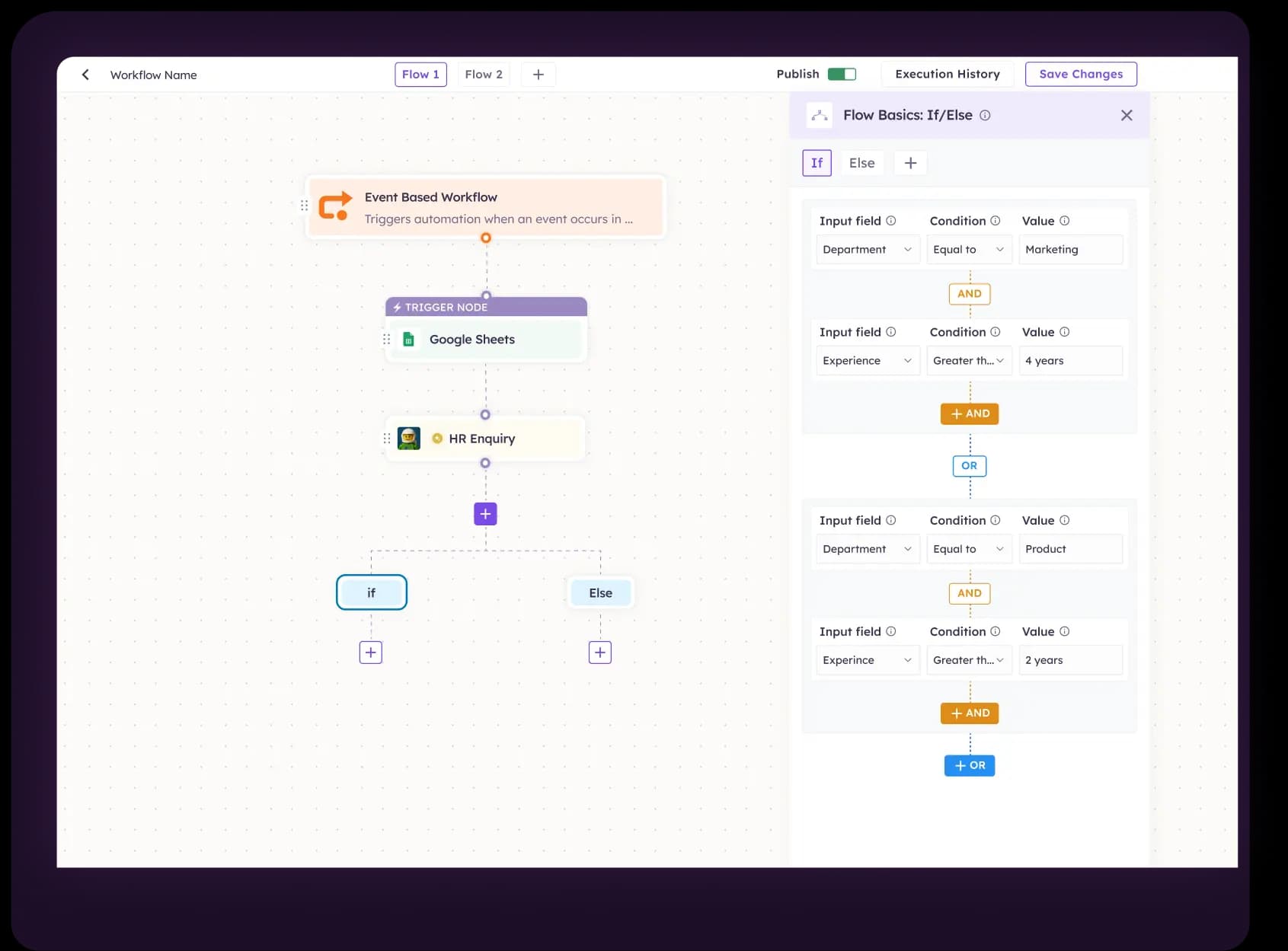
See the builder behind the workflow: an event, connected steps and explicit conditions on a single canvas.
The canvas shows an event-based workflow connected to a Google Sheets step and an enquiry branch. The condition panel defines which path is eligible; execution-history and publishing controls sit above the flow.
DESIGN AROUND THE JOB
Start with the responsibility and the systems it touches. Confirm the supported experience, operations and boundaries for your deployment.
Start the next responsibility when a source system confirms the customer’s state. Assign the onboarding work without assuming that an earlier meeting was a completed sale.
Example: a verified activation event creates an owned onboarding task.
Move a case when the required information or decision arrives. Keep it in an explicit waiting state when the prerequisite is missing.
Example: a missing-document response resumes the appropriate intake step.
Trigger permitted follow-up against current case state and contact rules. Stop or change the sequence when the customer responds or the work is no longer eligible.
Example: remind the current owner about an unresolved task.
Read the source of truth, perform a permitted operation in the destination and retain a reference linking the two.
Example: create a service task and verify its record and assigned owner.
VERIFIED WORK
Make the expected action, record and authority visible. Attempted, completed and unresolved work should not be reported as the same outcome.
| Work element | What to capture | Boundary to preserve |
|---|---|---|
| Trigger | A verified event or scheduled condition with a stable reference. | Check the source, required fields and duplicate-event handling. |
| Eligibility | The current business state and the conditions for starting work. | Do not infer a payment, approval or activation from a conversation. |
| Action & result | The requested operation and verified destination record. | Keep attempted, completed and unknown writes distinct. |
| Wait & recover | The missing condition, next owner and resumption event. | Define bounded retries and when a person must investigate. |
BEFORE PRODUCTION
Use representative cases and deliberate failures to test the experience. Evaluate what the employee actually does as well as what the customer sees.
Test duplicate delivery, stale updates and events that arrive in an unexpected sequence. Define the source-of-truth rule and the reference used to avoid duplicate work.
Test permission errors, timeouts and service interruptions. Preserve the work state and agree when to retry, reconcile or stop rather than restarting the entire journey.
Name the owner of a waiting task and the event that permits it to continue. Define expiry and escalation conditions so pending work does not silently disappear.
Review changes to routing, instructions, tools and permissions. Retest related paths and agree how affected work can be paused; rollback does not undo completed external writes.
A SCOPED PATH TO LAUNCH
Agree the prerequisites and acceptance criteria with the business and technical owners. Expand responsibility only after reviewing outcomes and unresolved risks.
Choose the role, outcome, eligible inputs and exceptions.
Output: responsibility and authority mapConfirm supported channels, data access and system operations.
Output: reviewed configuration and accessTest routine work, ambiguity, failed actions and human handoffs.
Output: case-level evidence and open issuesName the owner, review triggers and pause or recovery procedure.
Output: bounded release and operating planTWO WAYS TO START
The capability supports the employee’s responsibility. It does not replace the need for a clear job, permitted tools and an accountable owner.
Choose a defined role and scope the capabilities and connections needed for your team.
Explore the workforce →Design the job around your process, then connect the relevant channels, systems and handoffs.
Build your workforce →BUYER & IMPLEMENTATION QUESTIONS
Workflow automation is how an AI employee connects events, approved actions and exception handoffs so a process finishes without a person shepherding each step. The measure is the recorded outcome, not the number of steps triggered.
Workflow automation connects triggers, conditions and actions for a process. Workforce orchestration assigns and coordinates responsibilities across employees and people. They work together: an event may start an employee’s job, while orchestration determines who owns the next responsibility.
A supported system event or scheduled condition can be the starting point for a scoped workflow. Confirm available triggers and scheduling behavior for your deployment. The process still needs eligibility checks, permitted system operations and clear outcome evidence.
Define a stable request or event reference and the handling of repeated delivery. Inspect destination state before retrying uncertain writes. Use the retry and deduplication protections supported by each connected system.
Design explicit waiting states around verified prerequisites, such as a recorded decision or customer activation. Agree how supported events resume the process, who owns the wait and what happens if the event never arrives.
Preserve completed actions and the state of the affected step. Apply the defined recovery path and assign unresolved failures to an owner. Do not automatically repeat earlier actions that may already have succeeded or report the overall job complete.
That depends on your systems, available APIs and required operations. Inventory the exact products, versions, reads, writes and network constraints. Confirm native connections or scoped integration work before assuming a workflow can be deployed unchanged.
Yes, start by choosing the responsibility from the workforce listing, then confirm the channel, system connections and operating boundaries needed for your use case. A pre-built role is a starting point for scoping; it does not eliminate integration, access or evaluation requirements.
Agree the workflow outcome, permitted data and actions, exception owners and supported configuration. Test normal, ambiguous and failed cases in an approved environment. Review final records and release criteria before production; there is no universal implementation-time promise.




















CUSTOMER REVIEWS ON G2
BRING ONE REAL WORKFLOW
Share the intended outcome, systems and exceptions. We’ll map the capability to a defined responsibility and a supportable operating model.