

Sarah
Customer conversation · exampleCustomer
Can I change the delivery address for my order?
AI employee
I can check that. First, let’s complete the required identity check.
Identity not yet established
CHAT AGENTS · A WORKFORCE CAPABILITY
Resolve supported requests inside your systems, with the account context to act on and a clear route to a specialist.
FROM INTERACTION TO OUTCOME
Follow an order-address request through identity, eligibility and a verified update. Switch to an already-dispatched order to see why a good chat experience sometimes means holding the write and routing the request.
 UnleashX at workWorked example
Can I change the delivery address for my order?
I can check that. First, let’s complete the required identity check.
Capture intent; do not expose order details before identity checks.
Identity check required
AI employee
Routine actions proceed autonomously within configured permissions. Completion is reported only after the system result is verified.
INSIDE THE BUILDER
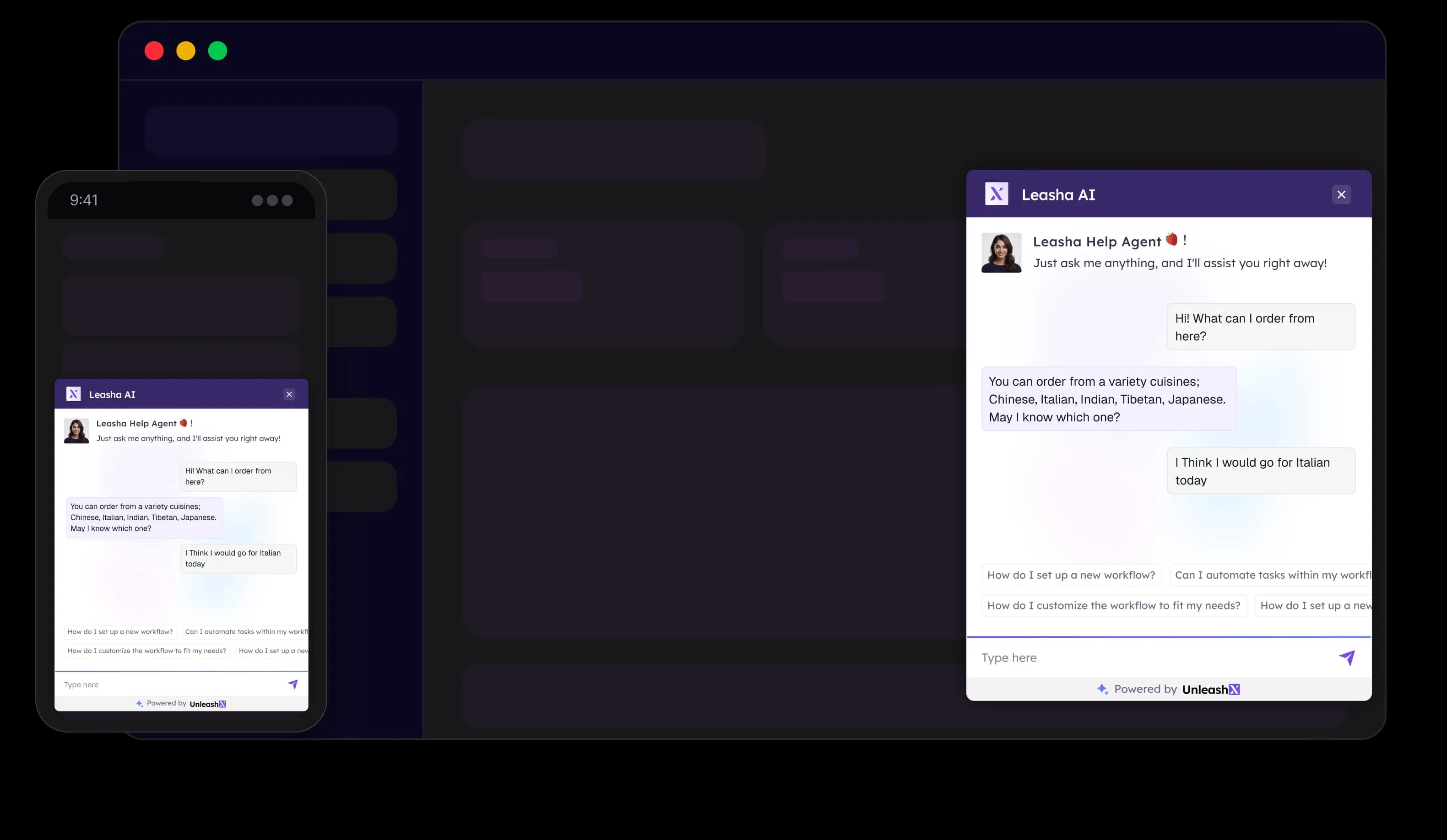
Give customers a familiar chat experience, backed by the knowledge and instructions you define for the role.
The desktop and mobile example shows how the chat widget sits inside the customer experience. Your employee’s responsibility determines what happens behind the conversation.
DESIGN AROUND THE JOB
Start with the responsibility and the systems it touches. Confirm the supported experience, operations and boundaries for your deployment.
Understand the issue, retrieve permitted case context and complete the supported resolution step. Keep uncertainty visible when the answer or system state is unclear.
Example: update an eligible order after the required identity checks.
Clarify the need, answer from approved product knowledge and capture the fields needed for a meaningful next step.
Example: qualify an enquiry and arrange a consultation with a verified booking.
Explain the next requirement, capture missing information and record progress against the customer’s actual setup state.
Example: guide a customer to complete a required workspace field.
Continue an agreed journey using the current record and contact preferences. Do not start a conflicting follow-up after work is complete.
Example: request a missing detail and return it to the existing case.
VERIFIED WORK
Make the expected action, record and authority visible. Attempted, completed and unresolved work should not be reported as the same outcome.
| Work element | What to capture | Boundary to preserve |
|---|---|---|
| Message & intent | The request, relevant thread context and unresolved questions. | Do not infer identity or permission from a message alone. |
| Source context | Approved guidance and the correct customer or order reference. | Access only the records and fields needed for the task. |
| Permitted action | Validated parameters and an eligible record state. | Confirm changes that require customer agreement before writing. |
| Outcome & ownership | Verified result, unresolved state or a named review owner. | A message sent to a reviewer is not a decision received. |
BEFORE PRODUCTION
Use representative cases and deliberate failures to test the experience. Evaluate what the employee actually does as well as what the customer sees.
Test incomplete requests, multiple matching records and pronouns that depend on earlier context. Require clarification before disclosing or changing customer-specific information.
Review stale guidance, unsupported questions and the information available in each messaging channel. Confirm supported channels, session continuity and retention arrangements.
Test repeated messages, concurrent requests and timeouts. Verify the final record rather than treating a friendly confirmation as evidence of completion.
Agree the destination and contents of a handoff. Preserve what the customer asked, what the employee did and what remains unresolved so people do not restart the conversation.
A SCOPED PATH TO LAUNCH
Agree the prerequisites and acceptance criteria with the business and technical owners. Expand responsibility only after reviewing outcomes and unresolved risks.
Choose the role, outcome, eligible inputs and exceptions.
Output: responsibility and authority mapConfirm supported channels, data access and system operations.
Output: reviewed configuration and accessTest routine work, ambiguity, failed actions and human handoffs.
Output: case-level evidence and open issuesName the owner, review triggers and pause or recovery procedure.
Output: bounded release and operating planTWO WAYS TO START
The capability supports the employee’s responsibility. It does not replace the need for a clear job, permitted tools and an accountable owner.
Choose a defined role and scope the capabilities and connections needed for your team.
Explore the workforce →Design the job around your process, then connect the relevant channels, systems and handoffs.
Build your workforce →BUYER & IMPLEMENTATION QUESTIONS
AI chat agents are AI employees working through the chat channel. Chat is a delivery surface, not the product: the same job also runs on voice, WhatsApp and email, and it is judged on the completed outcome and the record it leaves in your systems.
FAQ chatbots primarily return information. A chat-enabled AI employee can be scoped around a responsibility that includes approved system actions and exception handling. Evaluate whether the underlying job was completed correctly in the destination system.
Confirm the supported web and messaging channels for your deployment, including channel-specific access, identity and notification requirements. A shared workforce role does not mean that every channel has identical features or automatically shares all conversation history.
For supported operations within configured authority, that is the intended working model. Define the permitted fields, identity requirements and confirmation steps, then verify destination records in testing. Requests outside the allowed record state should be routed or refused, not forced through.
Scope the context available within a session and across an ongoing case. Agree identity matching, retention and access boundaries before enabling continuity. Do not assume unlimited memory or automatically merge separate people’s conversations.
The employee should preserve uncertainty, ask a useful clarification or route the request to the defined owner. Missing knowledge must not become an invented answer. Add representative gaps to the evaluation set and review source updates through change control.
When the request requires authority, judgment or system access beyond the employee’s scope, or a failure cannot be resolved safely. Routine permitted actions should not require unnecessary approvals. Agree how handoff and reviewer availability work for the selected channel.
Yes, start by choosing the responsibility from the workforce listing, then confirm the channel, system connections and operating boundaries needed for your use case. A pre-built role is a starting point for scoping; it does not eliminate integration, access or evaluation requirements.
Agree the workflow outcome, permitted data and actions, exception owners and supported configuration. Test normal, ambiguous and failed cases in an approved environment. Review final records and release criteria before production; there is no universal implementation-time promise.






















CUSTOMER REVIEWS ON G2
BRING ONE REAL WORKFLOW
Share the intended outcome, systems and exceptions. We’ll map the capability to a defined responsibility and a supportable operating model.