
As businesses race toward digital transformation, AI voice agent technologies have become a strategic differentiator. From customer service centers to automated sales outreach, the ability to Automate your calls using intelligent software dramatically reshapes how companies interact with customers. Yet behind every capable voice agent are two distinct but deeply intertwined technologies: Speech Recognition and Natural Language Processing (NLP). Understanding the difference between these layers?what each does and why it matters?unlocks greater clarity on how calling ai agent platforms deliver value.
This post breaks down the building blocks of modern voice AI, explains how they integrate to form powerful customer experiences, and shows the real conversational AI technology powering business transformation today.
Why Voice Matters in the Era of AI
Human communication is dominantly auditory. Even in digital contexts, people instinctively prefer voice over text because it feels more natural and efficient. The trillion-dollar question for business leaders has shifted from Why adopt voice AI? to How do we deploy voice intelligence responsibly and effectively?
Enter the ai voice agent.
Unlike traditional interactive voice response (IVR) systems that follow preprogrammed trees and rigid menus, next-generation calling ai agent platforms use advanced AI to listen, interpret, and respond in human-like ways. They deliver:
- Higher customer satisfaction
- Faster resolution times
- Conversational experiences that feel intuitive
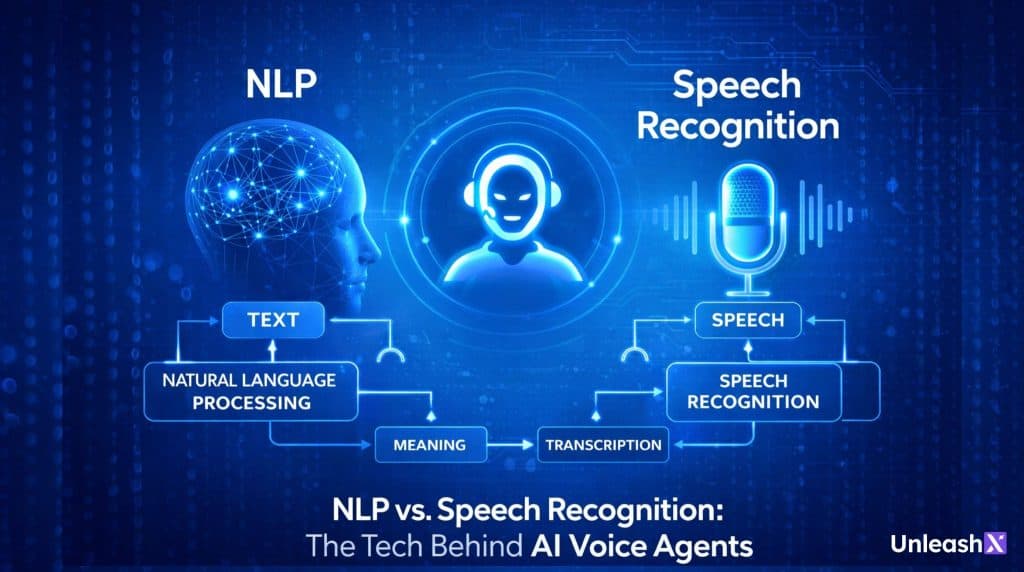
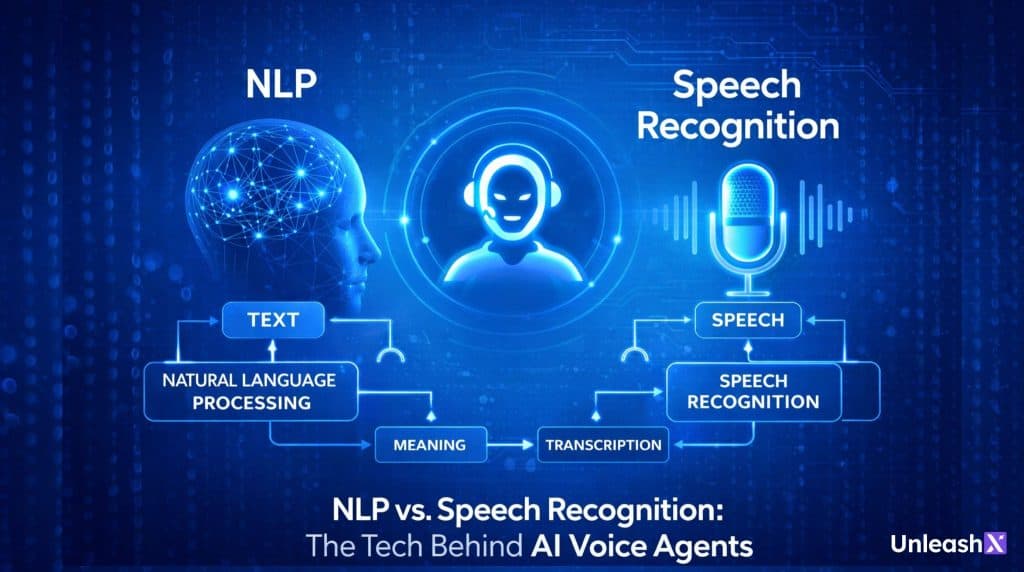
To build this level of sophistication, voice AI systems rely on two core technology pillars: Speech Recognition and Natural Language Processing (NLP).
What Is Speech Recognition?
At its core, speech recognition is the process of converting spoken language into written text. You speak, and it transcribes your voice into digital words.
This technology is foundational to speech to text for business calls, enabling machines to capture what customers say during conversations. Early speech recognition systems were brittle?poor accuracy, limited vocabularies, and significant lag. Modern implementations, however, leverage deep learning to deliver reliable performance even in noisy environments.
Here?s how it works in practice:
- Signal Processing: The system captures audio and breaks it into tiny frames (milliseconds long).
- Acoustic Modeling: Each audio frame is analyzed for phonetic patterns.
- Language Modeling: The system predicts the most likely sequence of words based on linguistic context.
- Transcription Output: Spoken input is transformed into text for further analysis.
This pipeline enables applications such as:
- Real-time call transcription
- Voice-driven command systems
- Automated note creation
- Sentiment and keyword analysis
For speech to text for business calls, accuracy is paramount. If a customer says ?refund,? but the system hears ?fund,? NLP downstream may misclassify intent. That?s why best-in-class systems apply robust language models to ensure reliable capture and interpretation.
What Is Natural Language Processing (NLP)?
While speech recognition captures what was said, NLP understands what it means.
NLP transforms raw text into structured information that machines can reason about. It?s the brain of a conversational AI technology system.
Core NLP capabilities include:
- Intent Recognition: Identifying why the user said something (e.g., ?I want a refund? vs ?I?m just asking?).
- Entity Extraction: Pulling out key details like order numbers, dates, product names, and locations.
- Sentiment Analysis: Gauging emotional tone to detect frustration or satisfaction.
- Context Tracking: Remembering prior exchanges to maintain conversation flow.
In practical terms, NLP enables an ai voice agent to do more than record words?it interprets meaning and responds logically. That?s how customers experience back-and-forth that feels natural instead of robotic. When your team leverages NLP for customer support automation, you?re equipping your system to understand context, reduce errors, and tailor responses to actual needs.
How Speech Recognition and NLP Work Together
Think of speech recognition as the ears and NLP as the brain of an ai voice agent.
Speech recognition captures the audio and delivers a text transcript. NLP then analyzes the text to determine intent, extract important details, and formulate an appropriate response.
Here?s a simplified example:
Customer calls: ?I want to change my delivery date for order 12345.?
- Speech Recognition: Converts spoken language into:
?I want to change my delivery date for order one two three four five.? - NLP Processing:
- Intent: Modify delivery
- Entities: Order Number = 12345
- Action: Route to rescheduling workflow
- Intent: Modify delivery
- Response Generated:
The calling ai agent says, ?Sure! Let?s update your delivery. What new date would you like??
This seamless flow?capture, understand, respond?is what elevates voice AI from transcription tools to full conversational partners.
Real-World Impact: Business Use Cases
Whether your organization runs a large call center or sells products online, the difference between static phone menus and a dynamic ai voice agent is dramatic.
1. Customer Support Automation
Modern customers expect fast resolution without friction. Through NLP for customer support automation, companies can automate common support requests such as:
- Balance checks
- Order status updates
- Password resets
- Service cancellations
This frees human agents to focus on complex, high-value interactions while reducing wait times and operational costs.
2. Sales Outreach
Calling is one of the most effective channels for engagement, yet it?s expensive when done manually. A calling ai agent can reach prospects at scale, deliver consistent messages, and handle conversations like:
- Appointment scheduling
- Follow-up reminders
- Lead qualification
- Survey completion
When paired with CRM data, voice agents personalize calls by name, reference past interactions, and even adapt messaging based on responses.
3. Feedback Collection
Surveys are most effective when easy to complete. An ai voice agent can conduct conversational feedback calls that feel human, enabling you to gather insights without manual dialing or manual note-taking.
4. Appointment Management
Healthcare, services, and consulting all rely heavily on appointment scheduling. Voice AI can check availability, confirm times, and reschedule bookings?reducing administrative burden and no-shows.
Key Benefits of Implementing AI Voice Agents
You can think of voice AI adoption in business through three lenses: efficiency, experience, and economics.
Efficiency
Voice agents handle routine interactions automatically, leading to:
- Faster resolution times
- Lower queue buildup
- 24/7 support without human scheduling
This helps you Automate your calls at scale without exponential increases in workforce.
Experience
Customers no longer endure rigid menus. Instead, they enjoy conversational responses that sound natural and intuitive. With accurate speech to text for business calls and strong conversational AI technology, conversations feel less like interactions with machines and more like helpful dialogue.
Economics
When routine calls are automated:
- Human agents focus on complex tasks
- Training overhead drops
- Resource allocation becomes strategic
Over time, this translates to measurable cost savings and higher ROI on customer support infrastructure.
Challenges and Misconceptions
As powerful as these technologies are, adopting voice AI isn?t plug-and-play. Common challenges include:
Accent, Noise, and Context Variance
? Background noise, diverse accents, and varied speech patterns can impact transcription accuracy. Modern systems mitigate this through advanced acoustic models, but it?s important to continuously train and test models against real-world data.
Overestimating NLP Capability
? NLP is powerful but not infallible. It excels at common patterns but may struggle with extremely niche or ambiguous requests unless trained on domain-specific data.
Integration Complexity
? Connecting voice AI systems to existing CRM, ticketing, or backend systems requires engineering effort and thoughtful design to ensure smooth data flow.
Privacy and Compliance
? Recording and processing voice data can trigger legal and ethical considerations. Strong governance and transparent consent mechanisms are essential.
Understanding these challenges up front ensures you build systems that are robust, ethical, and customer-centric.
Building Better Voice Agents: Design Principles
Creating effective ai voice agent experiences requires intention, not just technology adoption. Successful implementations prioritize:
Intent-First Design
? Start by identifying the most common intents customers express (e.g., refund inquiries, schedule changes). Build workflows that address these with minimal friction.
Context Awareness
? Systems should respect conversational context. If a customer mentions an earlier topic, the system must recall it naturally.
Fallback Safety
? When the voice agent cannot resolve a query, it should gracefully escalate to human support with clear handoff context.
Ongoing Learning
? Continual training using real customer interactions improves both speech recognition and NLP understanding over time.
This design philosophy ensures your voice AI does more than automate calls; it elevates the quality of every interaction.
Metrics That Matter
Measuring success is critical after launching any voice AI initiative. Key metrics include:
- Accuracy of Speech Recognition ? Percent of words correctly transcribed.
- Intent Recognition Accuracy ? How often the system correctly interprets user intent.
- First Call Resolution (FCR) ? The percentage of queries resolved without escalation.
- Customer Satisfaction (CSAT) ? Customer ratings after interactions.
- Cost per Interaction ? Operational cost savings compared to manual calls.
Tracking these over time builds confidence in your system and reveals areas for improvement.
The Future of Conversational AI Technology
Voice AI is moving fast. In the coming years, expect even deeper integration with:
- Emotion detection for tone-aware responses
- Multilingual support with real-time translation
- Proactive conversational outreach
- Hybrid human-AI agent collaboration
These advancements will redefine industries like healthcare, finance, retail, and public service, making calling ai agent capabilities essential to competitiveness.
Getting Started: A Practical Framework
Launching a voice AI strategy doesn?t have to be overwhelming. Here?s a practical framework:
- Define Use Cases
Pinpoint where automation yields the greatest impact?support, sales, feedback, etc. - Select Technology Stack
Choose platforms with strong speech recognition and NLP capabilities tailored to business needs. - Integrate with Backend Systems
Connect voice AI with CRM, ticketing, and analytics systems for seamless data flow. - Train Using Real Data
Use labeled interactions to refine models and improve accuracy. - Monitor Continuously
Use dashboards and logging to track performance and iterate. - Govern with Compliance
Ensure privacy, ethical use, and regulatory adherence throughout.
This pragmatic path balances innovation with control, allowing you to scale without chaos
Conclusion
Understanding the distinction between speech recognition and NLP reveals how modern ai voice agent systems power sophisticated, conversational experiences that transform business outcomes. When done well, voice automation delivers measurable ROI, better customer relationships, and operational resilience.
From speech to text for business calls to deep semantic understanding with NLP for customer support automation, the next generation of customer interaction technology is here.
If your business aims to Automate your calls, embracing voice AI isn?t just an upgrade?it?s a strategic imperative.