
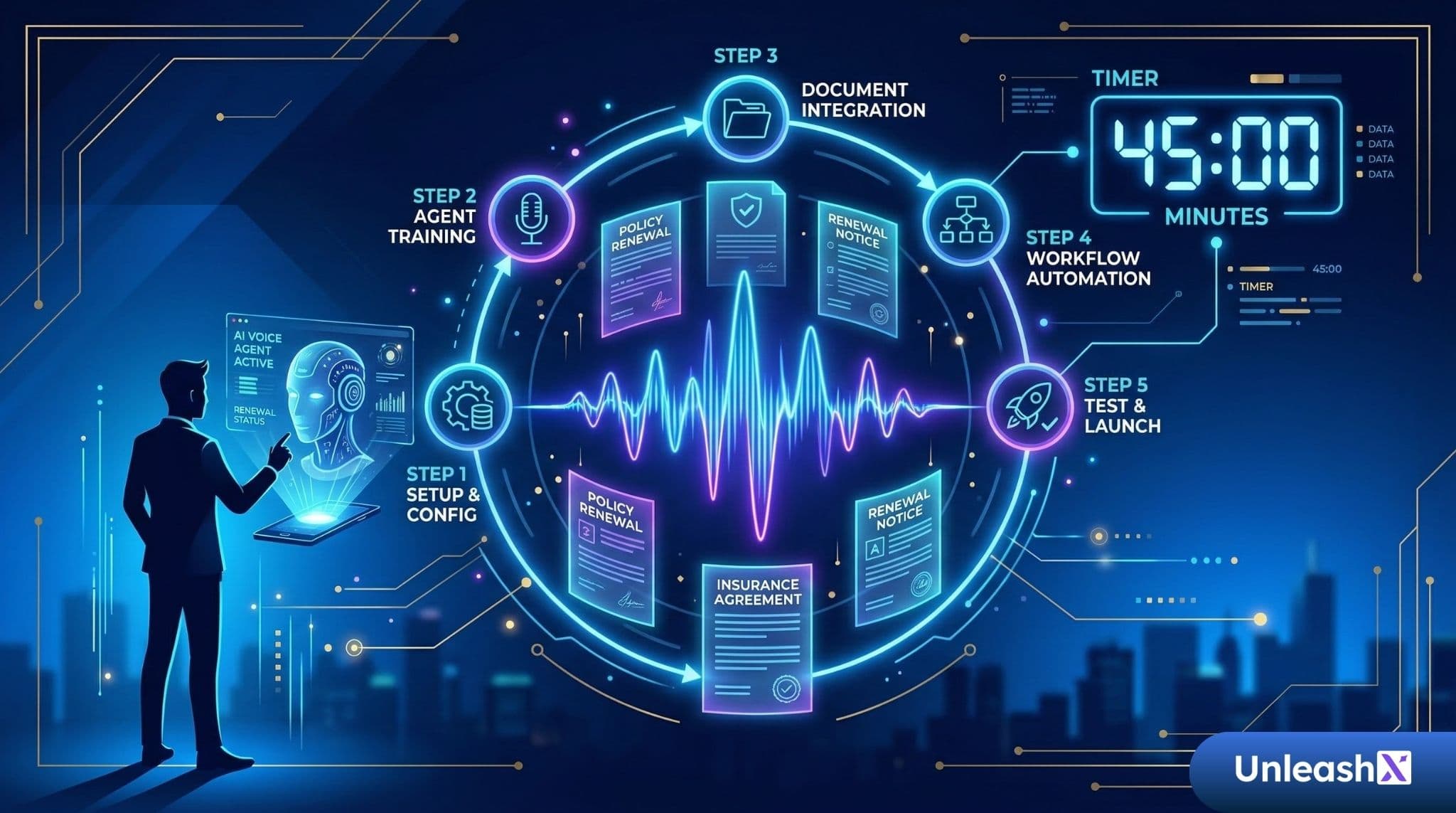
45 minutes. That’s not a typo.
Most insurance ops leaders assume that deploying intelligent automation means months of IT scoping, vendor negotiations, and painful system integrations. That used to be true. The landscape has changed significantly, and if your renewal team is still working manually, your policy lapse rate is already paying the price.
Today, a well-configured AI voice agent for insurance renewal can be live and making real outbound calls to real policyholders in under an hour. No custom code is required. There is no lengthy onboarding. There is no six-week implementation timeline. Here is exactly how it works, why it matters, and what to watch for along the way.
Why policy renewal automation can no longer wait
The average renewal team is stretched across hundreds or thousands of upcoming expirations, chasing policyholders who do not respond to emails, and manually logging every outreach attempt in a CRM that was never designed for this workflow.
The result is predictable. Policies lapse not because customers wanted to leave, but because nobody reached them in time. Research consistently shows that a large share of preventable lapses comes down to a failure of timely communication, not price, not dissatisfaction with the product. Insurers using AI-driven renewal workflows have reported a 25% reduction in policy lapses and a 20% increase in renewal conversions within the first quarter of deployment.
| Policies lapse not because customers wanted to leave, but because nobody reached them in time. AI-driven renewal outreach closes that gap permanently. |
Removing the manual bottleneck from outbound renewal outreach is the fastest lever most insurers have for improving retention. An AI voice agent does not get busy, does not forget, and does not stop at 5 PM. Every policyholder on your renewal list gets contacted on schedule, every time, across voice, WhatsApp, and SMS.
| 25%Reduction in policy lapses | 20%Increase in renewal conversions | 22%Less churn | 40%Cost savings on outreach |
Voice agents vs. renewal chatbots: why outbound changes everything
It is worth drawing this distinction clearly. Chatbots rely on policyholders initiating a conversation by visiting a portal, opening a message, or clicking a link. AI voice agents go to the policyholder. That difference is everything for renewal outreach.
Outbound AI calling achieves contact rates of 60 to 75%, compared to 20 to 30% for email campaigns. A phone call, even from an AI, gets answered. A renewal email sits unopened for days. Voice also handles nuance better: a policyholder who has questions about their premium or wants to adjust coverage before renewing can have that conversation in real time, with 98% accuracy and under 700ms latency. A chatbot simply cannot replicate that experience.
The 45-minute deployment: step by step
Here is what a deployment looks like on UnleashX, starting from a blank canvas.
Step 1: Connect your policyholder data (5 to 10 minutes)
Upload your renewal list as a CSV, a CRM export, or a direct API connection to your policy management system. The agent needs policyholder name, contact number, policy number, renewal date, and premium amount. That is enough to get started.
Step 2: Configure your renewal conversation flow (10 to 15 minutes)
Choose from pre-built insurance renewal templates and customize for your product line. Set your outreach cadence: 30 days out, 15 days, 7 days, and day-of. You are configuring conversation logic in a visual builder, not writing code. The workflow automation layer handles the sequencing automatically from there.
Step 3: Set escalation and handoff rules (5 minutes)
Decide which conversations stay with the AI and which route to a human. A policyholder who wants to cancel goes to retention. A complex coverage question transfers to a licensed agent with full call context already attached. Clean handoffs every time, without the customer having to repeat themselves.
Step 4: Enable multilingual support (5 minutes)
If you operate in multilingual markets, select your languages from the supported list. UnleashX supports 100+ global languages including Hindi, Tamil, Telugu, Marathi, Bengali, and 12+ Indian vernaculars. Configure regional greetings, toggle on, done.
Step 5: Test and go live (10 to 15 minutes)
Run a small test batch of 10 to 20 calls to verify audio quality, conversation flow, and CRM logging. Review the results, make final adjustments, then open it up to your full renewal list. You are live. Real calls. Real policyholders.
| 45 min | 98% | 100+ | 200+ |
| Conversation accuracy | Conversation accuracy | Languages supported | Ready integrations |
What happens after deployment
Going live is the beginning. The Policy Renewal Automation Agent runs every outbound campaign on schedule without supervision. Every call is logged, every response tracked, and every at-risk policyholder gets an automatic follow-up without anyone manually scheduling it.
Teams that have fully automated their renewal outreach report 35 to 50% reductions in lapse rates within the first quarter. Because the agent integrates directly with your CRM and policy system, your human team sees everything in real time: who confirmed, who needs a callback, who is at risk. Without touching a single call log.
| Teams that automate renewal outreach report 35 to 50% reductions in lapse rates within the first quarter. Not from better scripts. From better consistency. |
The numbers compound further over time. UnleashX customers have reported 46% faster client response times, 57% faster customer follow-ups, and 31% higher conversion from dormant leads after deploying AI voice workflows across sales and retention operations.
| 35-50% | 46% | 57% | 2.5x |
| Lapse rate reduction | Faster client responses | Faster follow-ups | Lead conversion uplift |
What to measure in the first 30 days
If you are deploying for the first time, resist the urge to optimize everything at once. There are four numbers that matter in the first month.
- Contact rate. The percentage of calls where a real conversation happens. 55 to 70% is healthy for insurance outbound. If you are below that, your calling window is likely the issue. Calls between 10 and 11 AM and 5 to 7 PM consistently outperform other windows.
- Escalation rate. Every transfer to a human is a signal. Above 15% usually means the agent is encountering questions outside its knowledge base. That is a configuration gap, not a technology problem, and it is straightforward to fix from the transcript data.
- Intent capture rate. Of connected calls, how many ended with the customer expressing intent to renew? 40 to 60% is a realistic target in the first month. Lower than that, and the objection handling needs refinement.
- Conversion from the full sequence. After the complete multi-touch cycle, what percentage of contacted customers actually renewed? Compare this directly against your baseline from manual outreach. The lift becomes visible within two to three weeks.
What to look for in a platform
Not all platforms are equal. When evaluating options for AI-driven policy renewal automation, here is what actually matters for a regulated insurance environment:
- Native insurance workflow templates. Generic call center tools adapted for insurance miss the specific workflows that matter: renewal cadences, premium objections, escalation to licensed agents, IRDAI-aligned compliance logging.
- Real-time CRM and policy system integration. The agent needs live data. A yesterday-export approach leads to incorrect premium figures on calls, which erodes customer trust immediately.
- Compliance built in. Every call recorded, every required disclosure logged, every interaction auditable. PII redaction, consent logging, DND scrubbing, and regulated calling hours are non-negotiable in insurance.
- Multilingual support for your actual markets. For Indian insurers especially, regional language support is the difference between a good contact rate and an excellent one. See the full voice AI capabilities here.
- Conversation flows your team can see and adjust. If you need an engineer every time you want to update an objection response, the platform is not built for ops teams. Explore the Agenthub to see how UnleashX handles this.
The right platform makes deploying a voice agent feel like configuring a campaign. See UnleashX pricing or book a demo to see it in action.
Who should be doing this now
If you are an insurance ops head managing a renewal book of any meaningful size, this is not a future initiative. It is a current-quarter decision. Every month of manual outreach is a month of preventable lapses. The AI insurance workforce infrastructure to make this switch exists today and deployment is measured in hours, not months.
If you are a renewal team lead watching your agents spend half their day on calls that follow the same script every time, there is a better use of their skills. The calls that need human judgment, the escalations, the retention conversations, the high-value relationships, those are where your team should be spending their time.
The 40% cost savings and 27% improvement in contact rates that insurers are seeing with AI-driven outreach are not projections. They are benchmarks across mid-to-large insurers already running these workflows. The best time to deploy was last quarter. The second-best time is now.